
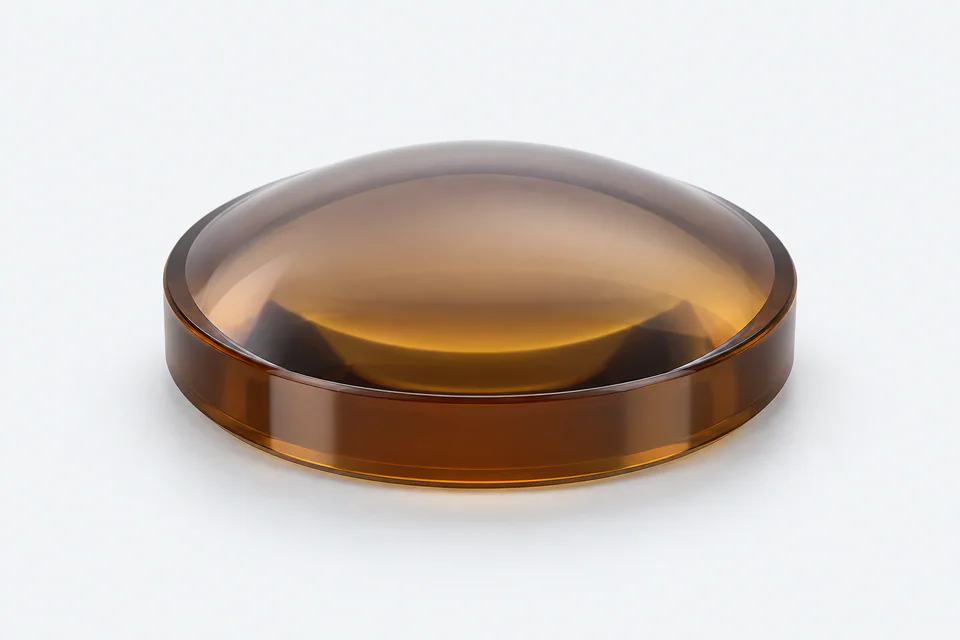
Chalcogenide Aspheric Lenses
Chalcogenide glass's moldability (see Chalcogenide Glass Lenses) is especially well suited to aspheric lens production, since the non-spherical profile can be molded directly rather than ground — this combination (moldable material + aspheric shape) is a documented, real product line used in cost-relevant volume thermal-imaging optics.
Share requirements, quantities and a drawing if available. Specifications and supply terms require confirmation.
Overview
Chalcogenide glass's moldability (see Chalcogenide Glass Lenses) is especially well suited to aspheric lens production, since the non-spherical profile can be molded directly rather than ground — this combination (moldable material + aspheric shape) is a documented, real product line used in cost-relevant volume thermal-imaging optics. Procurement review should center on combining an aspheric profile with a selected chalcogenide glass to reduce infrared system complexity.
Key Selection Points
- Moldable material particularly well suited to aspheric lens volume production
- Broadband mid/long-wave IR transmission
Applications
General category applications; suitability for a specific part requires confirmation.
Thermal imaging optical systems
Lens Geometry & Selection Guide
This module explains how lens geometry changes the selection path and the information required from the optical design. For Chalcogenide Aspheric Lenses, the module focuses on combining an aspheric profile with a selected chalcogenide glass to reduce infrared system complexity.
- Show surface orientation, optical axis and conjugate or beam condition in the drawing.
- Include focal length, prescription and aberration targets with the enquiry for feasibility review.
- State tolerance and manufacturable-range requirements on the drawing for review.
- Product-specific review: connect glass grade with infrared band and document the trade-off against a spherical chalcogenide lens.
Prepare a product-specific enquiry
Include the requirements you know and identify any points that need confirmation.
| RFQ input | What to provide |
|---|---|
| Input 1 | Define the buyer objective for Chalcogenide Aspheric Lenses: combining an aspheric profile with a selected chalcogenide glass to reduce infrared system complexity. |
| Input 2 | Optical inputs: glass grade; aspheric prescription. |
| Input 3 | Geometry and interface: infrared band; coating and mount. |
| Input 4 | Special review note: provide both the material designation and complete aspheric coefficient convention. |
| Input 5 | State quantity and project stage without assuming MOQ, inventory or delivery timing. |
| Input 6 | Name the drawing revision and acceptance evidence required for review. |
Frequently Asked Questions
Why is chalcogenide glass suited to aspheric lenses specifically?
Because it can be molded directly into a non-spherical (aspheric) shape, which is generally more cost-relevant at volume than grinding an aspheric profile into a crystalline material like germanium.
Which specification should be fixed first for Chalcogenide Aspheric Lenses?
Begin with glass grade. It determines how aspheric prescription and infrared band should be evaluated before the mechanical details are finalized.
When is Chalcogenide Aspheric Lenses a better fit than a spherical chalcogenide lens?
Choose between them by testing the requirement for combining an aspheric profile with a selected chalcogenide glass to reduce infrared system complexity. If that requirement is absent, the comparison product may provide a simpler procurement path.
What should an RFQ for Chalcogenide Aspheric Lenses include?
Provide both the material designation and complete aspheric coefficient convention. Also include quantity, drawing revision and the required acceptance evidence. Final availability is confirmed during quotation.
Which details for Chalcogenide Aspheric Lenses still require supplier verification?
Actual material and coating availability, dimensional limits, tolerances, inspection reports, MOQ and lead time cannot be inferred from this page and must be confirmed against the RFQ.
Related Products & Resources
Explore Related Resources
Tell us what you are sourcing.
A product name, a specification or an application is a starting point.