
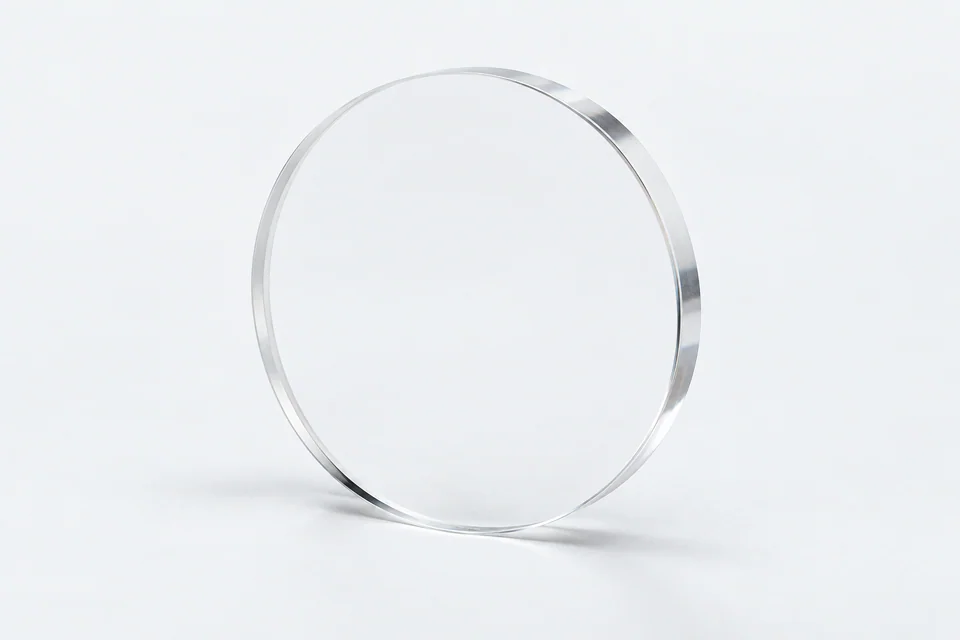
Fused Silica Optical Windows
Fused silica (quartz) windows for applications needing broadband UV-to-IR transmission and material purity.
Share requirements, quantities and a drawing if available. Specifications and supply terms require confirmation.
Overview
Fused silica (also called fused quartz) is amorphous SiO2 with low thermal expansion and broadband transmission from the UV through the visible and into the near-IR, with UV-grade material extending further into the deep UV. Standard grade designations used across the industry include JGS1 (high-purity, UV-grade), JGS2 (general-purpose visible/NIR) and JGS3 (IR-grade) — which grade Dongqiao actually sources is confirmed separately below, not assumed from the general naming convention. Procurement review should center on preserving a low-distortion UV or visible optical path under thermal or illumination changes.
Key Selection Points
- Broadband UV–visible–NIR transmission, extending further into the UV for UV-grade material
- Low thermal expansion relative to ordinary optical glass
Applications
General category applications; suitability for a specific part requires confirmation.
UV applications
General optical instrumentation
Laboratory and process windows
Wavelength Range & Material Guide
This module connects wavelength needs with material choice while keeping reference properties separate from configuration-specific performance. For Fused Silica Optical Windows, the module focuses on preserving a low-distortion UV or visible optical path under thermal or illumination changes.
- Separate general material behavior from the exact grade and coating offered for the RFQ.
- Review environmental, thermal and handling constraints alongside the wavelength band.
- Confirm any numerical transmission range for the selected material, coating and configuration.
- Product-specific review: connect spectral band with wavefront or flatness need and document the trade-off against BK7/K9 windows.
Prepare a product-specific enquiry
Include the requirements you know and identify any points that need confirmation.
| RFQ input | What to provide |
|---|---|
| Input 1 | Procurement objective for Fused Silica Optical Windows: preserving a low-distortion UV or visible optical path under thermal or illumination changes. |
| Input 2 | Lock spectral band before requesting a decision on fused-silica grade. |
| Input 3 | Describe wavefront or flatness need and the mating or operating condition for coating and thermal environment. |
| Input 4 | Do not omit this product-specific point: identify whether the window protects imaging, metrology, UV illumination or a laser path. |
| Input 5 | Include quantity and project phase; MOQ, stock and lead time are confirmed during quotation. |
| Input 6 | Identify drawing revision, critical notes and evidence needed at acceptance. |
Frequently Asked Questions
Is fused silica the same as quartz?
"Fused silica" and "quartz" are commonly used interchangeably in this market for the same amorphous SiO2 material; this page uses both terms.
Which specification should be fixed first for Fused Silica Optical Windows?
Begin with spectral band. It determines how fused-silica grade and wavefront or flatness need should be evaluated before the mechanical details are finalized.
When is Fused Silica Optical Windows a better fit than BK7/K9 windows?
Choose between them by testing the requirement for preserving a low-distortion UV or visible optical path under thermal or illumination changes. If that requirement is absent, the comparison product may provide a simpler procurement path.
What should an RFQ for Fused Silica Optical Windows include?
Identify whether the window protects imaging, metrology, UV illumination or a laser path. Also include quantity, drawing revision and the required acceptance evidence. Final availability is confirmed during quotation.
Which details for Fused Silica Optical Windows still require supplier verification?
Actual material and coating availability, dimensional limits, tolerances, inspection reports, MOQ and lead time cannot be inferred from this page and must be confirmed against the RFQ.
Related Products & Resources
Explore Related Resources
Tell us what you are sourcing.
A product name, a specification or an application is a starting point.