
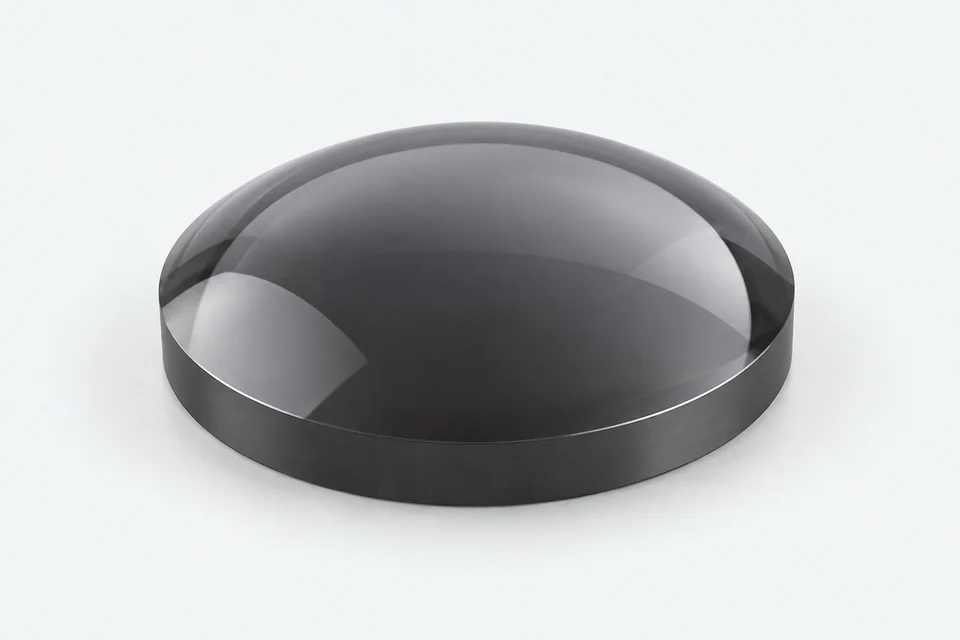
Germanium (Ge) Lenses
Germanium transmits strongly through the mid- and long-wave infrared (roughly 2–14µm), the same material property that makes germanium windows a standard choice for thermal-imaging systems — in lens form, it is commonly used to focus or image within the same optical paths.
Share requirements, quantities and a drawing if available. Specifications and supply terms require confirmation.
Overview
Germanium transmits strongly through the mid- and long-wave infrared (roughly 2–14µm), the same material property that makes germanium windows a standard choice for thermal-imaging systems — in lens form, it is commonly used to focus or image within the same optical paths. Plano-convex and meniscus are common lens shapes in this category. Procurement review should center on combining germanium material behavior with lens power in a thermal-imaging optical train.
Key Selection Points
- Broad LWIR/MWIR transmission range, same material basis as Germanium Optical Windows
- Common standard shapes (plano-convex, meniscus) exist in this category
Applications
General category applications; suitability for a specific part requires confirmation.
Thermal imaging camera lens assemblies
Infrared optical systems
Lens Geometry & Selection Guide
This module explains how lens geometry changes the selection path and the information required from the optical design. For Germanium (Ge) Lenses, the module focuses on combining germanium material behavior with lens power in a thermal-imaging optical train.
- Show surface orientation, optical axis and conjugate or beam condition in the drawing.
- Include focal length, prescription and aberration targets with the enquiry for feasibility review.
- State tolerance and manufacturable-range requirements on the drawing for review.
- Product-specific review: connect infrared band and detector with germanium grade and document the trade-off against ZnSe or chalcogenide lenses.
Prepare a product-specific enquiry
Include the requirements you know and identify any points that need confirmation.
| RFQ input | What to provide |
|---|---|
| Input 1 | Define the buyer objective for Germanium (Ge) Lenses: combining germanium material behavior with lens power in a thermal-imaging optical train. |
| Input 2 | Optical inputs: infrared band and detector; lens form and focal requirement. |
| Input 3 | Geometry and interface: germanium grade; coating, temperature and mount. |
| Input 4 | Special review note: provide focal requirement, lens orientation, detector band and allowable mechanical envelope. |
| Input 5 | State quantity and project stage without assuming MOQ, inventory or delivery timing. |
| Input 6 | Name the drawing revision and acceptance evidence required for review. |
Frequently Asked Questions
Do you offer an aspheric version?
Yes — see Germanium Aspheric Lenses for the single-element aspheric option.
Which specification should be fixed first for Germanium (Ge) Lenses?
Begin with infrared band and detector. It determines how lens form and focal requirement and germanium grade should be evaluated before the mechanical details are finalized.
When is Germanium (Ge) Lenses a better fit than ZnSe or chalcogenide lenses?
Choose between them by testing the requirement for combining germanium material behavior with lens power in a thermal-imaging optical train. If that requirement is absent, the comparison product may provide a simpler procurement path.
What should an RFQ for Germanium (Ge) Lenses include?
Provide focal requirement, lens orientation, detector band and allowable mechanical envelope. Also include quantity, drawing revision and the required acceptance evidence. Final availability is confirmed during quotation.
Which details for Germanium (Ge) Lenses still require supplier verification?
Actual material and coating availability, dimensional limits, tolerances, inspection reports, MOQ and lead time cannot be inferred from this page and must be confirmed against the RFQ.
Tell us what you are sourcing.
A product name, a specification or an application is a starting point.