
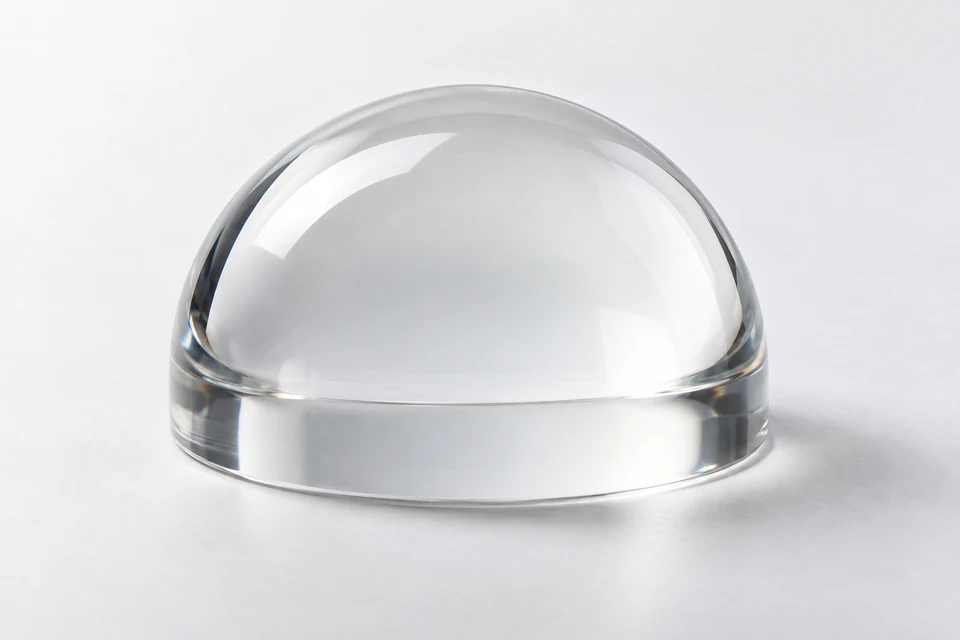
Half-Ball Lenses
A ball lens cut in half, with a flat mounting face that lets it sit flush against a fiber ferrule or sensor housing.
Share requirements, quantities and a drawing if available. Specifications and supply terms require confirmation.
Overview
A half-ball lens is a ball lens sectioned to leave one flat face, which is useful specifically where the lens must be mounted flush against a fiber ferrule, sensor window or housing — a mechanical requirement full ball lenses cannot meet. Optically it behaves similarly to a full ball lens for the curved-surface half, giving the same short back-focal-length coupling benefit in a more mountable package. Procurement review should center on using a flat mounting face to position a short-focus spherical element against a ferrule or sensor.
Key Selection Points
- Flat mounting face allows direct, flush attachment to a fiber ferrule or housing
- Retains the short back focal length and wide acceptance angle of a full ball lens
Applications
Half-ball lenses are used in the same fiber-optic coupling and compact sensing applications as full ball lenses, wherever the lens must mount flush against a flat surface — for example, directly onto a fiber ferrule, a sensor die, or a housing wall.
Structure & Configuration
This module describes the physical configuration and interfaces that distinguish the product from a generic optic. For Half-Ball Lenses, the module focuses on using a flat mounting face to position a short-focus spherical element against a ferrule or sensor.
- Use a labeled cross-section or configuration drawing with clear datums.
- Separate optical clear zones from mounting, sealing and handling surfaces.
- Include dimensional and inspection requirements with the enquiry for feasibility review.
- Product-specific review: connect half-ball diameter with flat-face orientation and document the trade-off against a full ball lens.
Prepare a product-specific enquiry
Include the requirements you know and identify any points that need confirmation.
| RFQ input | What to provide |
|---|---|
| Input 1 | Use case for Half-Ball Lenses: document using a flat mounting face to position a short-focus spherical element against a ferrule or sensor. |
| Input 2 | First decision pair: half-ball diameter versus material. |
| Input 3 | Integration pair: flat-face orientation together with fiber spacing and mount. |
| Input 4 | RFQ-specific instruction: show whether the flat face contacts the ferrule, sensor or spacer and define the optical axis. |
| Input 5 | Add the requested quantity and prototype or production stage. |
| Input 6 | Attach controlled drawings and identify the inspection or spectral evidence the buyer expects. |
Frequently Asked Questions
Why choose a half-ball lens over a full ball lens?
The flat face lets it mount flush against a fiber ferrule, sensor or housing wall — a full ball lens has no flat surface to attach to.
Can you supply a custom diameter or flat-face tolerance?
Half-Ball Lenses requires this decision to be tied to half-ball diameter and material. Share your drawing or exact specification through the RFQ form and we will confirm feasibility.
Which specification should be fixed first for Half-Ball Lenses?
Begin with half-ball diameter. It determines how material and flat-face orientation should be evaluated before the mechanical details are finalized.
When is Half-Ball Lenses a better fit than a full ball lens?
Choose between them by testing the requirement for using a flat mounting face to position a short-focus spherical element against a ferrule or sensor. If that requirement is absent, the comparison product may provide a simpler procurement path.
What should an RFQ for Half-Ball Lenses include?
Show whether the flat face contacts the ferrule, sensor or spacer and define the optical axis. Also include quantity, drawing revision and the required acceptance evidence. Final availability is confirmed during quotation.
Related Products & Resources

Explore Related Resources
Tell us what you are sourcing.
A product name, a specification or an application is a starting point.