
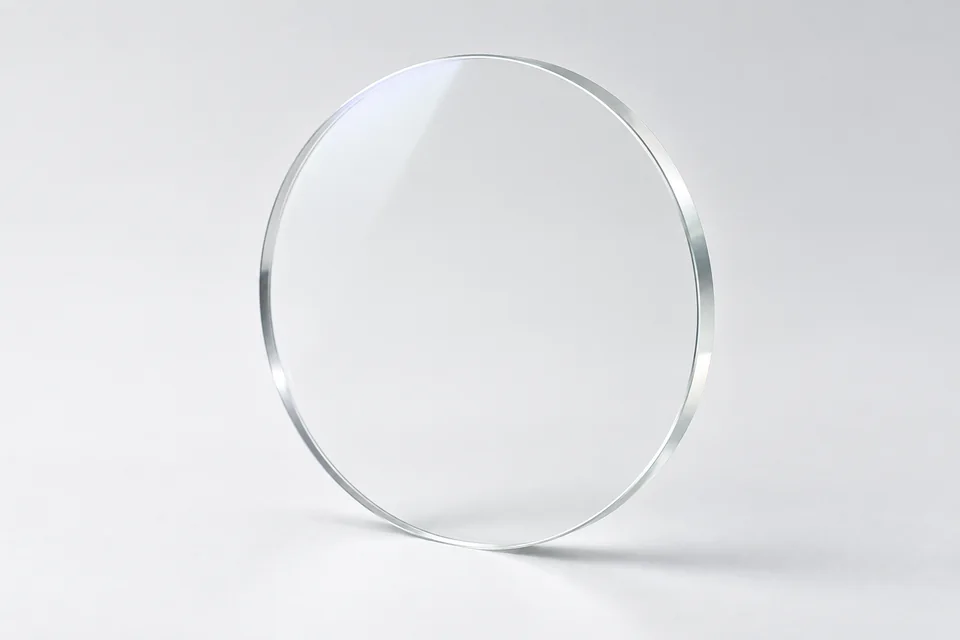
Laser Protective Windows
A replaceable optical window that shields the focusing lens of a fiber laser cutting or welding head from spatter and debris.
Share requirements, quantities and a drawing if available. Specifications and supply terms require confirmation.
Overview
Laser protective windows (also called debris windows or cover glass) are the sacrificial optic mounted in front of the focusing lens on a fiber laser cutting, welding or cleaning head. Because they take the direct impact of spatter and process debris, they are designed to be replaced on a routine basis rather than repaired — the actual replacement interval depends on material, coating, cutting duty and installation position, so it stays unconfirmed here rather than promised. Procurement review should center on protecting downstream laser optics from process debris without silently changing the intended beam path.
Key Selection Points
- Consumable, drop-in design — protects the more expensive focusing lens behind it and is meant to be swapped rather than cleaned/repaired
- Upper (collimation-side) and lower (process-side) positions serve different roles on the head; lower windows are generally replaced more often because they face the cut directly
- Fast RFQ path for buyers who already know their head model/part number
Applications
General category applications; suitability for a specific part requires confirmation.
Fiber laser cutting
Fiber laser welding
Fiber laser cleaning
Spectral Performance
This module explains which spectral variables must be defined before measured performance can be reviewed. For Laser Protective Windows, the module focuses on protecting downstream laser optics from process debris without silently changing the intended beam path.
- Review measured performance against supplier or test-lab data tied to the exact configuration.
- Record wavelength region, angle of incidence and polarization with the measurement context.
- Confirm transmission, reflectance and blocking requirements against approved evidence for the selected configuration.
- Product-specific review: connect laser wavelength and exposure regime with clear aperture and thickness envelope and document the trade-off against a general cover window.
Prepare a product-specific enquiry
Include the requirements you know and identify any points that need confirmation.
| RFQ input | What to provide |
|---|---|
| Input 1 | System context: explain why Laser Protective Windows is being considered for protecting downstream laser optics from process debris without silently changing the intended beam path. |
| Input 2 | Required optical definition: laser wavelength and exposure regime, then substrate and coating compatibility. |
| Input 3 | Required physical definition: clear aperture and thickness envelope, then mounting, contamination and replacement conditions. |
| Input 4 | Product distinction to record: state laser source, wavelength, exposure context and whether the window is sacrificial or permanent. |
| Input 5 | Provide the required quantity and program phase. |
| Input 6 | List the applicable drawing, test reference and acceptance basis. |
Frequently Asked Questions
What is the difference between an upper and a lower protective window?
Upper (collimation-side) windows sit closer to the fiber/collimator; lower (process-side) windows face the cutting zone directly and are generally replaced more often in this market. Confirm the exact position needed for your head model when requesting a quote.
Is this the same thing as a "debris window" or "cover glass"?
Yes — these are different trade names for the same product used in different supplier/market registers. This page covers all of them.
Do I need an AR-coated version?
Most fiber-laser protective windows in this market use an AR coating; confirm your exact coating requirement when you send your specification.
Can I get a custom size or drawing-based part?
Share your drawing or exact dimensions through the RFQ form and we will confirm feasibility.
Which specification should be fixed first for Laser Protective Windows?
Begin with laser wavelength and exposure regime. It determines how substrate and coating compatibility and clear aperture and thickness envelope should be evaluated before the mechanical details are finalized.
Related Products & Resources
Explore Related Resources
Tell us what you are sourcing.
A product name, a specification or an application is a starting point.