
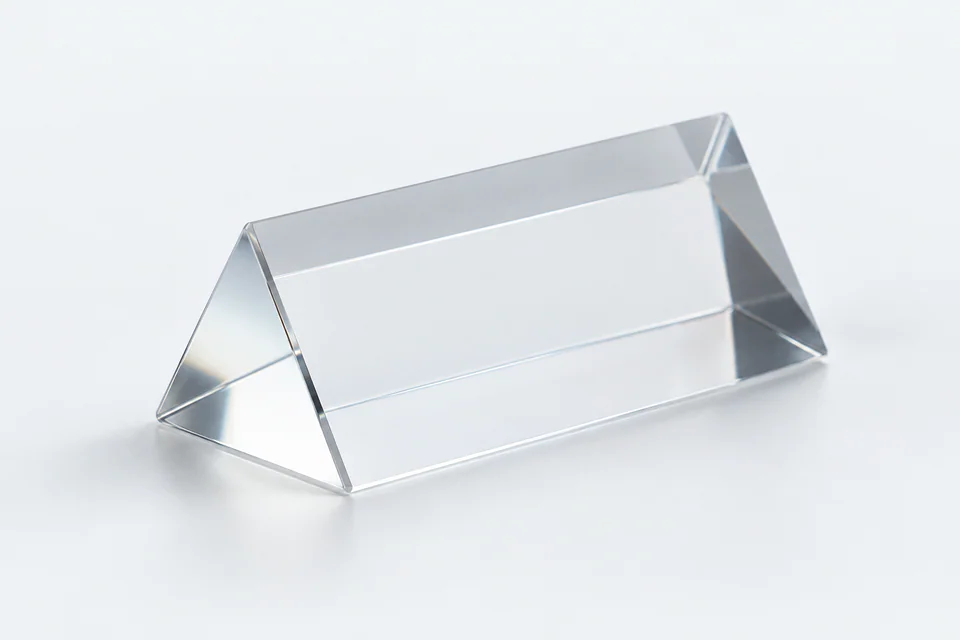
Equilateral Prisms
A 60-degree equilateral prism used to disperse light into its spectral components for spectroscopy and laser-tuning applications.
Share requirements, quantities and a drawing if available. Specifications and supply terms require confirmation.
Overview
An equilateral prism has three equal 60-degree angles and works by refraction, bending different wavelengths by different amounts to spread white or broadband light into its spectral components. This dispersion function is what makes it a standard element in spectroscopy instruments and wavelength-tuning laser cavities — a different optical function from the beam-folding or beam-splitting prisms elsewhere in this catalog. Infrared-grade materials such as CaF2, germanium or ZnSe are used when the application needs dispersion outside the visible band. Procurement review should center on dispersing light or deviating a beam through a symmetric prism geometry.
Key Selection Points
- Disperses light by wavelength through refraction, a different function from beam-folding (Right Angle) or beam-erecting (Roof) prisms also carried in this catalog
- Standard element in spectroscopy instruments and laser wavelength-tuning cavities
Applications
Equilateral prisms are used in spectroscopy instruments to disperse light for spectral analysis, and in tunable laser cavities to select a wavelength by rotating the prism.
Optical Principle & Light Path
This module makes the intended light path and component orientation explicit for review. For Equilateral Prisms, the module focuses on dispersing light or deviating a beam through a symmetric prism geometry.
- Diagram entrance and exit beams, optical axis and relevant face orientation.
- Identify wavelength, angle of incidence and polarization where they affect the principle.
- Use the light-path diagram to clarify component orientation; measured performance remains configuration-specific.
- Product-specific review: connect apex angle with beam incidence geometry and document the trade-off against a wedge prism.
Prepare a product-specific enquiry
Include the requirements you know and identify any points that need confirmation.
| RFQ input | What to provide |
|---|---|
| Input 1 | System context: explain why Equilateral Prisms is being considered for dispersing light or deviating a beam through a symmetric prism geometry. |
| Input 2 | Required optical definition: apex angle, then material dispersion. |
| Input 3 | Required physical definition: beam incidence geometry, then orientation and surface coating. |
| Input 4 | Product distinction to record: state whether the task is dispersion, deviation or calibration and define the apex orientation. |
| Input 5 | Provide the required quantity and program phase. |
| Input 6 | List the applicable drawing, test reference and acceptance basis. |
Frequently Asked Questions
What is an equilateral prism used for?
Its main use is dispersing light into its spectral components — bending different wavelengths by different amounts — for spectroscopy instruments and wavelength-tuning laser cavities. This is a different function from beam-folding or beam-erecting prisms.
Can you supply a custom equilateral prism from a drawing?
Equilateral Prisms requires this decision to be tied to apex angle and material dispersion. Share your drawing or exact dimensions through the RFQ form and we will confirm feasibility.
Which specification should be fixed first for Equilateral Prisms?
Begin with apex angle. It determines how material dispersion and beam incidence geometry should be evaluated before the mechanical details are finalized.
When is Equilateral Prisms a better fit than a wedge prism?
Choose between them by testing the requirement for dispersing light or deviating a beam through a symmetric prism geometry. If that requirement is absent, the comparison product may provide a simpler procurement path.
What should an RFQ for Equilateral Prisms include?
State whether the task is dispersion, deviation or calibration and define the apex orientation. Also include quantity, drawing revision and the required acceptance evidence. Final availability is confirmed during quotation.
Related Products & Resources
Explore Related Resources
Tell us what you are sourcing.
A product name, a specification or an application is a starting point.