
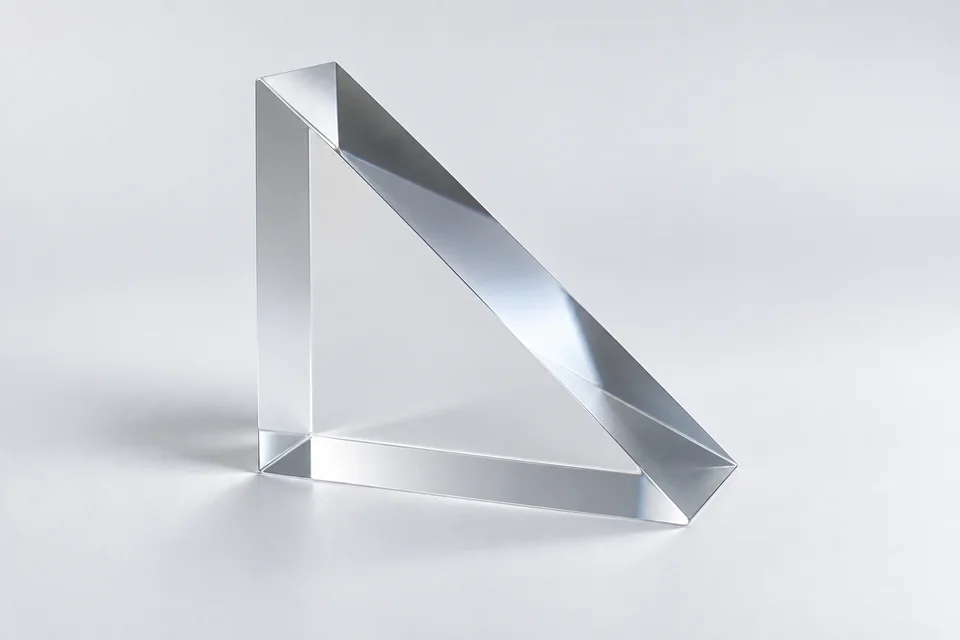
Right Angle Prisms
A 45-45-90 prism used to fold a light path by 90 or 180 degrees, one of the most common standard catalog optical components.
Share requirements, quantities and a drawing if available. Specifications and supply terms require confirmation.
Overview
A right angle prism has a 45-45-90 triangular cross-section and is used to fold or redirect a light path by 90 degrees (via one reflecting face) or 180 degrees (via total internal reflection off the hypotenuse), depending on which face the light enters. It is one of the most standardized shapes in optics, used across instrument alignment, periscope-style beam folding and general optical-path design. Procurement review should center on turning or folding a beam by a known angle while controlling prism orientation and reflective-face treatment.
Key Selection Points
- Folds a light path by 90 or 180 degrees depending on orientation
- Can use total internal reflection (no coating needed) or a reflective coating depending on the angle of use
Applications
Right angle prisms are used to fold optical paths in instruments, periscopes and alignment systems, and as retroreflectors via total internal reflection where a coated mirror would otherwise be needed.
Optical Principle & Light Path
This module makes the intended light path and component orientation explicit for review. For Right Angle Prisms, the module focuses on turning or folding a beam by a known angle while controlling prism orientation and reflective-face treatment.
- Diagram entrance and exit beams, optical axis and relevant face orientation.
- Identify wavelength, angle of incidence and polarization where they affect the principle.
- Use the light-path diagram to clarify component orientation; measured performance remains configuration-specific.
- Product-specific review: connect leg and hypotenuse geometry with total-internal-reflection or coating intent and document the trade-off against a mirror-based fold.
Prepare a product-specific enquiry
Include the requirements you know and identify any points that need confirmation.
| RFQ input | What to provide |
|---|---|
| Input 1 | System context: explain why Right Angle Prisms is being considered for turning or folding a beam by a known angle while controlling prism orientation and reflective-face treatment. |
| Input 2 | Required optical definition: leg and hypotenuse geometry, then beam entrance face. |
| Input 3 | Required physical definition: total-internal-reflection or coating intent, then orientation and mounting datum. |
| Input 4 | Product distinction to record: draw the incoming and outgoing beam directions and identify any coated face. |
| Input 5 | Provide the required quantity and program phase. |
| Input 6 | List the applicable drawing, test reference and acceptance basis. |
Frequently Asked Questions
Does a right angle prism need a reflective coating?
Not always — when light enters through the leg faces and reflects off the hypotenuse at the correct angle, total internal reflection folds the path without any coating. A coating is only needed for other entry/exit configurations.
What is the difference between a right angle prism and a roof prism?
A right angle prism has a simple flat hypotenuse and folds or redirects a beam; a roof prism has a 90-degree 'roof' edge on one face that also erects/reverses the image, which a simple right angle prism does not do.
Can you supply a custom size or coating?
Right Angle Prisms requires this decision to be tied to leg and hypotenuse geometry and beam entrance face. Share your drawing or exact specification through the RFQ form and we will confirm feasibility.
Which specification should be fixed first for Right Angle Prisms?
Begin with leg and hypotenuse geometry. It determines how beam entrance face and total-internal-reflection or coating intent should be evaluated before the mechanical details are finalized.
When is Right Angle Prisms a better fit than a mirror-based fold?
Choose between them by testing the requirement for turning or folding a beam by a known angle while controlling prism orientation and reflective-face treatment. If that requirement is absent, the comparison product may provide a simpler procurement path.
Related Products & Resources
Explore Related Resources
Tell us what you are sourcing.
A product name, a specification or an application is a starting point.