
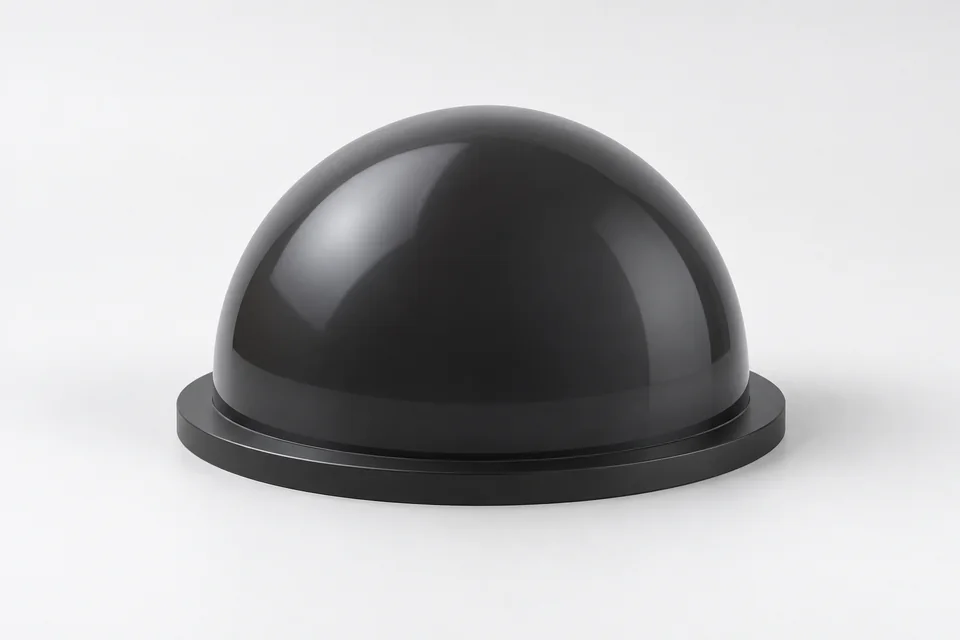
Infrared (IR) Domes
Dome-shaped IR windows used to protect thermal-imaging sensors and cameras while preserving the field of view.
Share requirements, quantities and a drawing if available. Specifications and supply terms require confirmation.
Overview
A dome window is a curved (typically hemispherical) optical window used where a flat window would restrict the field of view or create an aerodynamic/mechanical mounting problem — thermal-camera housings, gimbals and sensor pods are common real-world uses. Materials used for IR domes in this market include zinc sulfide (ZnS) and germanium, in addition to the sapphire domes covered on a separate page. Procurement review should center on protecting a wide-angle infrared sensor without clipping its field of view.
Key Selection Points
- Hemispherical shape preserves a wide field of view compared to a flat window
- Available in more than one IR material depending on the application
- Used across thermal-imaging and sensor-protection housings
Applications
General category applications; suitability for a specific part requires confirmation.
Thermal camera protection
Gimbal / UAV sensor housings
General sensor-protection housings
Structure & Configuration
This module describes the physical configuration and interfaces that distinguish the product from a generic optic. For Infrared (IR) Domes, the module focuses on protecting a wide-angle infrared sensor without clipping its field of view.
- Use a labeled cross-section or configuration drawing with clear datums.
- Separate optical clear zones from mounting, sealing and handling surfaces.
- Include dimensional and inspection requirements with the enquiry for feasibility review.
- Product-specific review: connect material and infrared band with field of view and boresight and document the trade-off against a flat infrared window.
Prepare a product-specific enquiry
Include the requirements you know and identify any points that need confirmation.
| RFQ input | What to provide |
|---|---|
| Input 1 | System context: explain why Infrared (IR) Domes is being considered for protecting a wide-angle infrared sensor without clipping its field of view. |
| Input 2 | Required optical definition: material and infrared band, then outer and inner dome geometry. |
| Input 3 | Required physical definition: field of view and boresight, then mounting flange and environmental load. |
| Input 4 | Product distinction to record: state the sensor field of view, dome center relationship and mounting datum. |
| Input 5 | Provide the required quantity and program phase. |
| Input 6 | List the applicable drawing, test reference and acceptance basis. |
Frequently Asked Questions
Is this compatible with my camera housing?
Share your housing dimensions/drawing through the RFQ form and we will confirm fit.
What is the difference between this page and the Sapphire Domes page?
This page covers zinc sulfide and germanium IR domes; sapphire domes are covered on their own page because sapphire spans both industrial/IR and other use cases.
Which specification should be fixed first for Infrared (IR) Domes?
Begin with material and infrared band. It determines how outer and inner dome geometry and field of view and boresight should be evaluated before the mechanical details are finalized.
When is Infrared (IR) Domes a better fit than a flat infrared window?
Choose between them by testing the requirement for protecting a wide-angle infrared sensor without clipping its field of view. If that requirement is absent, the comparison product may provide a simpler procurement path.
What should an RFQ for Infrared (IR) Domes include?
State the sensor field of view, dome center relationship and mounting datum. Also include quantity, drawing revision and the required acceptance evidence. Final availability is confirmed during quotation.
Related Products & Resources
Explore Related Resources
Tell us what you are sourcing.
A product name, a specification or an application is a starting point.