
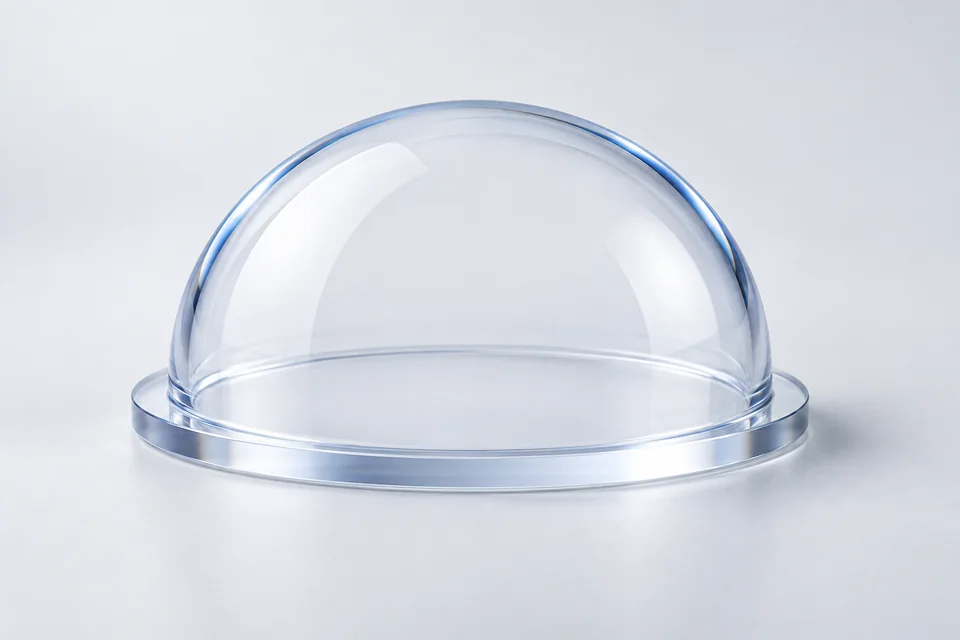
Sapphire Domes
Sapphire domes for applications that need a very hard, curved protective window over a sensor or camera.
Share requirements, quantities and a drawing if available. Specifications and supply terms require confirmation.
Overview
A sapphire dome combines sapphire's hardness and broadband transmission with a curved (typically hemispherical) shape that preserves field of view for a sensor or camera behind it. Standard, common-diameter hemispherical domes are a normal catalog item across this market; larger, hyper-hemispherical, stepped/flanged or otherwise advanced-geometry domes are generally a drawing-led custom/precision order rather than a stock item, and this page does not make any defense- or aerospace-capability claim. Procurement review should center on using sapphire dome geometry for a protective sensor envelope where optical and mechanical interfaces interact.
Key Selection Points
- Very hard, scratch- and abrasion-resistant material
- Hemispherical shape preserves field of view for the sensor/camera behind it
Applications
General category applications; suitability for a specific part requires confirmation.
Sensor and camera protection housings
General high-durability optical dome use
Structure & Configuration
This module describes the physical configuration and interfaces that distinguish the product from a generic optic. For Sapphire Domes, the module focuses on using sapphire dome geometry for a protective sensor envelope where optical and mechanical interfaces interact.
- Use a labeled cross-section or configuration drawing with clear datums.
- Separate optical clear zones from mounting, sealing and handling surfaces.
- Include dimensional and inspection requirements with the enquiry for feasibility review.
- Product-specific review: connect dome aperture and angular coverage with wall geometry and edge interface and document the trade-off against a flat sapphire window.
Prepare a product-specific enquiry
Include the requirements you know and identify any points that need confirmation.
| RFQ input | What to provide |
|---|---|
| Input 1 | Procurement objective for Sapphire Domes: using sapphire dome geometry for a protective sensor envelope where optical and mechanical interfaces interact. |
| Input 2 | Lock dome aperture and angular coverage before requesting a decision on sapphire orientation or grade. |
| Input 3 | Describe wall geometry and edge interface and the mating or operating condition for coating and sealing environment. |
| Input 4 | Do not omit this product-specific point: supply dome radii, wall definition, clear zone and flange or bond interface. |
| Input 5 | Include quantity and project phase; MOQ, stock and lead time are confirmed during quotation. |
| Input 6 | Identify drawing revision, critical notes and evidence needed at acceptance. |
Frequently Asked Questions
How durable is a sapphire dome compared to glass or plastic?
Sapphire is significantly harder than ordinary optical glass or plastic, which is a key reason it is used for protective domes where scratch resistance matters.
Can this be custom-shaped (larger diameter, stepped, flanged)?
Non-standard dome geometries are generally handled as a drawing-led custom order in this market — share your drawing and we will confirm feasibility.
Which specification should be fixed first for Sapphire Domes?
Begin with dome aperture and angular coverage. It determines how sapphire orientation or grade and wall geometry and edge interface should be evaluated before the mechanical details are finalized.
When is Sapphire Domes a better fit than a flat sapphire window?
Choose between them by testing the requirement for using sapphire dome geometry for a protective sensor envelope where optical and mechanical interfaces interact. If that requirement is absent, the comparison product may provide a simpler procurement path.
What should an RFQ for Sapphire Domes include?
Supply dome radii, wall definition, clear zone and flange or bond interface. Also include quantity, drawing revision and the required acceptance evidence. Final availability is confirmed during quotation.
Related Products & Resources

Explore Related Resources
Tell us what you are sourcing.
A product name, a specification or an application is a starting point.