
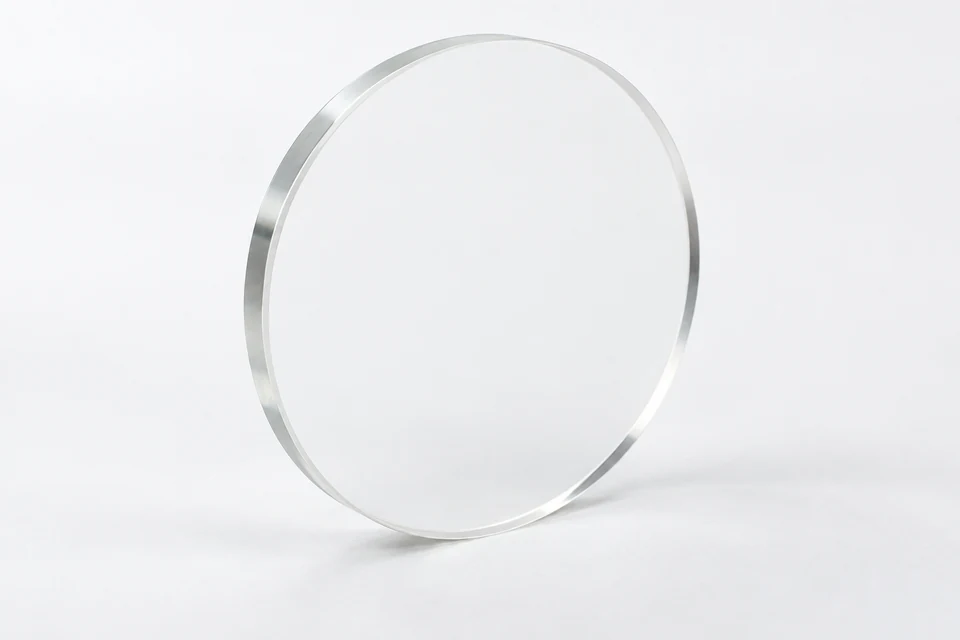
Magnesium Fluoride (MgF2) Windows
A fluoride crystal window used for deep-ultraviolet transmission down to around 120nm, for spectroscopy and instrumentation applications where standard fused silica or CaF2 no longer transmits.
Share requirements, quantities and a drawing if available. Specifications and supply terms require confirmation.
Overview
Magnesium fluoride is a fluoride crystal material with one of the shortest usable transmission cutoffs of any common optical window material, extending into the deep and vacuum ultraviolet. This makes it a standard choice for excimer-laser and deep-UV spectroscopy applications that fall below the transmission range of fused silica or calcium fluoride. It complements Dongqiao's existing CaF2 Optical Windows page as part of the same broader fluoride-optics material family. Procurement review should center on using MgF2 for ultraviolet access while accounting for crystal orientation and polarization effects.
Key Selection Points
- Transmits into the deep and vacuum ultraviolet, shorter wavelength cutoff than fused silica or CaF2
- Used in excimer-laser and deep-UV spectroscopy instrumentation in this product category
- Part of the same fluoride-crystal material family as CaF2, which Dongqiao already sources
Applications
MgF2 windows are used in deep-UV and vacuum-UV spectroscopy, excimer laser systems, and other UV instrumentation applications requiring transmission below the practical range of fused silica or calcium fluoride.
Wavelength Range & Material Guide
This module connects wavelength needs with material choice while keeping reference properties separate from configuration-specific performance. For Magnesium Fluoride (MgF2) Windows, the module focuses on using MgF2 for ultraviolet access while accounting for crystal orientation and polarization effects.
- Separate general material behavior from the exact grade and coating offered for the RFQ.
- Review environmental, thermal and handling constraints alongside the wavelength band.
- Confirm any numerical transmission range for the selected material, coating and configuration.
- Product-specific review: connect UV wavelength band with polarization sensitivity and document the trade-off against fused-silica windows.
Prepare a product-specific enquiry
Include the requirements you know and identify any points that need confirmation.
| RFQ input | What to provide |
|---|---|
| Input 1 | Define the buyer objective for Magnesium Fluoride (MgF2) Windows: using MgF2 for ultraviolet access while accounting for crystal orientation and polarization effects. |
| Input 2 | Optical inputs: UV wavelength band; MgF2 orientation or grade. |
| Input 3 | Geometry and interface: polarization sensitivity; coating, thickness and mount. |
| Input 4 | Special review note: state UV band, polarization state and whether crystal-axis orientation is controlled. |
| Input 5 | State quantity and project stage without assuming MOQ, inventory or delivery timing. |
| Input 6 | Name the drawing revision and acceptance evidence required for review. |
Frequently Asked Questions
How is MgF2 different from CaF2 or fused silica windows?
MgF2 transmits further into the deep and vacuum ultraviolet than either fused silica or CaF2, making it the material of choice for the shortest-wavelength UV applications. For less extreme UV or visible/IR use, CaF2 or fused silica is generally more cost-relevant — see our CaF2 Optical Windows and Fused Silica Optical Windows pages.
Can I get a custom size or drawing-based part for Magnesium Fluoride (MgF2) Windows?
Magnesium Fluoride (MgF2) Windows requires this decision to be tied to UV wavelength band and MgF2 orientation or grade. Share your drawing or exact dimensions through the RFQ form and we will confirm feasibility.
Which specification should be fixed first for Magnesium Fluoride (MgF2) Windows?
Begin with UV wavelength band. It determines how MgF2 orientation or grade and polarization sensitivity should be evaluated before the mechanical details are finalized.
When is Magnesium Fluoride (MgF2) Windows a better fit than fused-silica windows?
Choose between them by testing the requirement for using MgF2 for ultraviolet access while accounting for crystal orientation and polarization effects. If that requirement is absent, the comparison product may provide a simpler procurement path.
What should an RFQ for Magnesium Fluoride (MgF2) Windows include?
State UV band, polarization state and whether crystal-axis orientation is controlled. Also include quantity, drawing revision and the required acceptance evidence. Final availability is confirmed during quotation.
Related Products & Resources


Explore Related Resources
Tell us what you are sourcing.
A product name, a specification or an application is a starting point.