
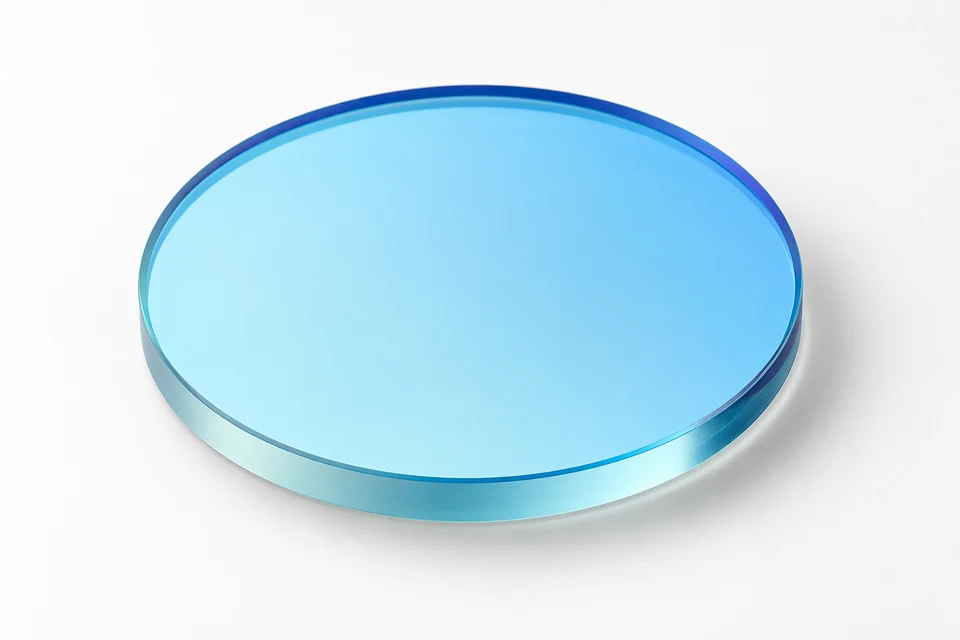
Shortpass Filters
A filter that transmits wavelengths below a defined cut-off point and blocks longer wavelengths.
Share requirements, quantities and a drawing if available. Specifications and supply terms require confirmation.
Overview
A shortpass filter transmits light below a defined 'cut-off' wavelength while blocking longer wavelengths — the mirror-image behavior of a longpass filter. It is commonly used to block infrared/heat while passing visible light, for example in camera IR-cut applications, or wherever an application needs only the shorter-wavelength portion of a spectrum. Procurement review should center on transmitting wavelengths below a cutoff while rejecting the longer band.
Key Selection Points
- Single cut-off edge design, the mirror-image counterpart to a longpass filter also carried in this catalog
- Common in IR-cut/heat-blocking applications and visible-band imaging systems
Applications
Shortpass filters are used to block infrared/heat while passing visible light in cameras and optical instruments, and generally wherever an application needs only the shorter-wavelength portion of the spectrum and nothing above its cutoff.
Spectral Performance
This module explains which spectral variables must be defined before measured performance can be reviewed. For Shortpass Filters, the module focuses on transmitting wavelengths below a cutoff while rejecting the longer band.
- Review measured performance against supplier or test-lab data tied to the exact configuration.
- Record wavelength region, angle of incidence and polarization with the measurement context.
- Confirm transmission, reflectance and blocking requirements against approved evidence for the selected configuration.
- Product-specific review: connect cut-off wavelength with short-wavelength pass region and document the trade-off against a bandpass filter.
Prepare a product-specific enquiry
Include the requirements you know and identify any points that need confirmation.
| RFQ input | What to provide |
|---|---|
| Input 1 | Use case for Shortpass Filters: document transmitting wavelengths below a cutoff while rejecting the longer band. |
| Input 2 | First decision pair: cut-off wavelength versus transition slope. |
| Input 3 | Integration pair: short-wavelength pass region together with long-wavelength blocking region and AOI. |
| Input 4 | RFQ-specific instruction: state cut-off definition, usable pass region, blocking interval and AOI. |
| Input 5 | Add the requested quantity and prototype or production stage. |
| Input 6 | Attach controlled drawings and identify the inspection or spectral evidence the buyer expects. |
Frequently Asked Questions
What is the difference between a shortpass filter and a Heat Absorbing filter?
A shortpass filter blocks longer wavelengths using a thin-film coating with a sharp cutoff edge; a heat absorbing filter blocks heat using bulk absorption in the glass itself (no coating), with a gentler roll-off. They use different technologies for a similar practical goal.
Can you supply a custom cut-off wavelength?
Share your target cut-off wavelength through the RFQ form and we will confirm feasibility once a coating source is confirmed.
Which specification should be fixed first for Shortpass Filters?
Begin with cut-off wavelength. It determines how transition slope and short-wavelength pass region should be evaluated before the mechanical details are finalized.
When is Shortpass Filters a better fit than a bandpass filter?
Choose between them by testing the requirement for transmitting wavelengths below a cutoff while rejecting the longer band. If that requirement is absent, the comparison product may provide a simpler procurement path.
What should an RFQ for Shortpass Filters include?
State cut-off definition, usable pass region, blocking interval and AOI. Also include quantity, drawing revision and the required acceptance evidence. Final availability is confirmed during quotation.
Related Products & Resources
Explore Related Resources
Tell us what you are sourcing.
A product name, a specification or an application is a starting point.