
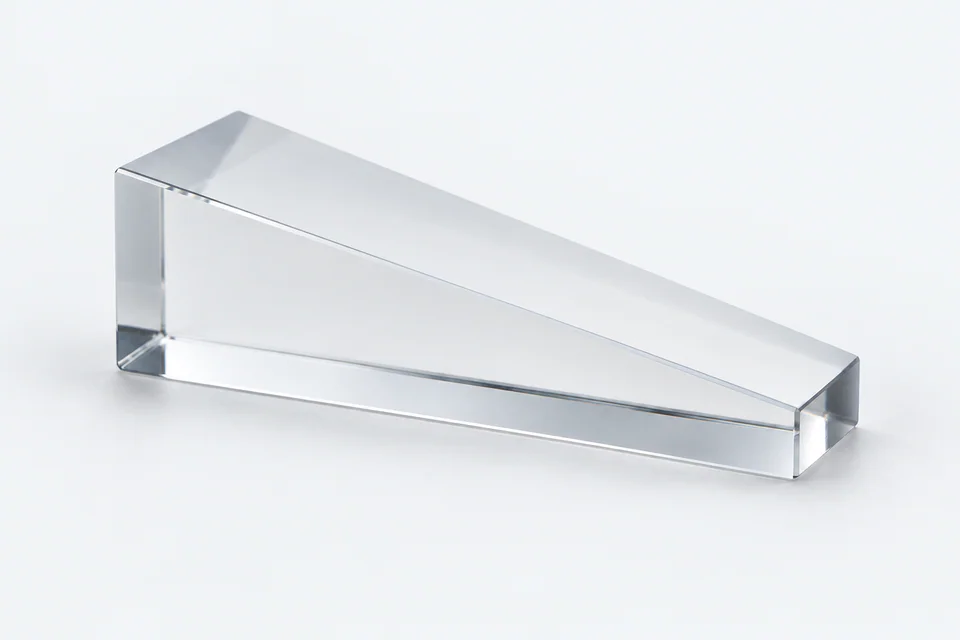
Wedge Prisms
A thin prism with a small angle between its two faces, used to deviate a beam by a small, precise angle rather than fold or disperse it.
Share requirements, quantities and a drawing if available. Specifications and supply terms require confirmation.
Overview
A wedge prism has a small angle (commonly in the range of 0. 5 to 5 degrees) between its two flat faces, which deviates a transmitted beam by a small, precise angle without significant dispersion or folding. A single wedge prism gives fixed deviation; pairing two wedge prisms in a counter-rotating mount (a Risley prism pair) allows the deviation angle and direction to be continuously adjusted, a real technique used in laser beam-steering, tracking and scanning systems. Procurement review should center on introducing a small angular deviation or separating unwanted reflections through a controlled wedge.
Key Selection Points
- Deviates a beam by a small, precise angle without folding or significant dispersion
- Pairs of wedge prisms (Risley prism configuration) enable continuously adjustable beam steering
Applications
Wedge prisms are used in laser beam-steering and tracking systems, free-space laser communication, LiDAR scanning, and optical alignment applications where a small, precisely controlled beam deviation is needed.
Optical Principle & Light Path
This module makes the intended light path and component orientation explicit for review. For Wedge Prisms, the module focuses on introducing a small angular deviation or separating unwanted reflections through a controlled wedge.
- Diagram entrance and exit beams, optical axis and relevant face orientation.
- Identify wavelength, angle of incidence and polarization where they affect the principle.
- Use the light-path diagram to clarify component orientation; measured performance remains configuration-specific.
- Product-specific review: connect wedge angle and direction with clear aperture and document the trade-off against a parallel window.
Prepare a product-specific enquiry
Include the requirements you know and identify any points that need confirmation.
| RFQ input | What to provide |
|---|---|
| Input 1 | Procurement objective for Wedge Prisms: introducing a small angular deviation or separating unwanted reflections through a controlled wedge. |
| Input 2 | Lock wedge angle and direction before requesting a decision on beam deviation objective. |
| Input 3 | Describe clear aperture and the mating or operating condition for coating and orientation mark. |
| Input 4 | Do not omit this product-specific point: define wedge magnitude and azimuth, incidence angle and desired beam separation. |
| Input 5 | Include quantity and project phase; MOQ, stock and lead time are confirmed during quotation. |
| Input 6 | Identify drawing revision, critical notes and evidence needed at acceptance. |
Frequently Asked Questions
What is a Risley prism pair?
It is two wedge prisms mounted so they can rotate independently — by adjusting their relative rotation, the combined beam deviation angle and direction can be continuously varied, a standard technique in laser beam-steering and scanning systems.
Can you supply a custom wedge angle or size?
Wedge Prisms requires this decision to be tied to wedge angle and direction and beam deviation objective. Share your drawing or exact specification through the RFQ form and we will confirm feasibility.
Which specification should be fixed first for Wedge Prisms?
Begin with wedge angle and direction. It determines how beam deviation objective and clear aperture should be evaluated before the mechanical details are finalized.
When is Wedge Prisms a better fit than a parallel window?
Choose between them by testing the requirement for introducing a small angular deviation or separating unwanted reflections through a controlled wedge. If that requirement is absent, the comparison product may provide a simpler procurement path.
What should an RFQ for Wedge Prisms include?
Define wedge magnitude and azimuth, incidence angle and desired beam separation. Also include quantity, drawing revision and the required acceptance evidence. Final availability is confirmed during quotation.
Related Products & Resources


Explore Related Resources
Tell us what you are sourcing.
A product name, a specification or an application is a starting point.