
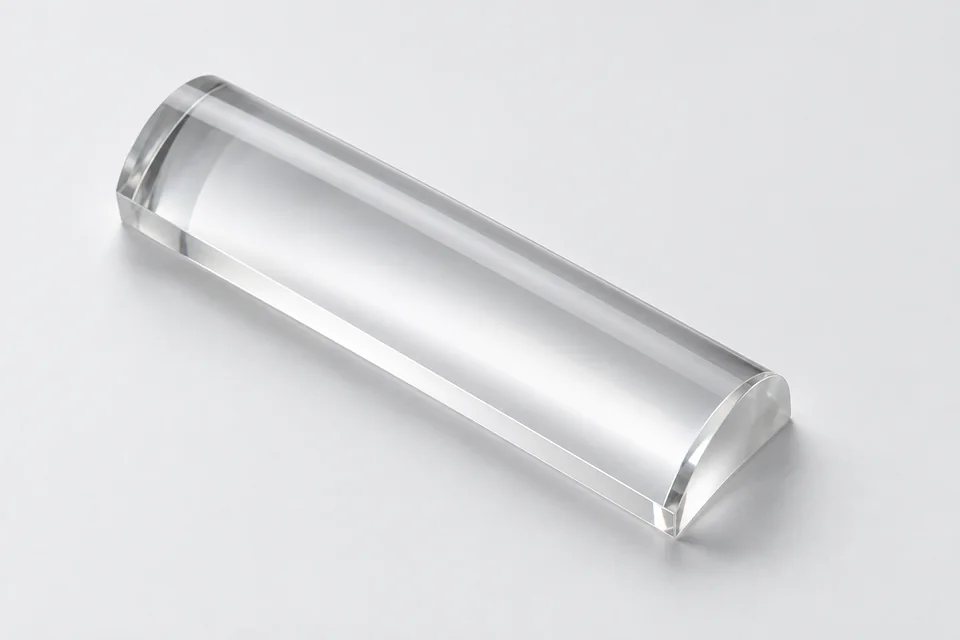
Cylindrical Lenses
A lens that focuses or diverges light in only one axis, used to generate laser lines or reshape a beam's aspect ratio.
Share requirements, quantities and a drawing if available. Specifications and supply terms require confirmation.
Overview
A cylindrical lens has curvature in only one axis and none in the perpendicular axis, so it focuses or expands light along one direction while leaving the other unaffected — a fundamentally different function from spherical lenses, which act equally in both axes. This makes it the standard choice for generating a laser line (as used in barcode scanners and machine-vision structured-light systems) or reshaping the round beam from a laser diode into a more usable elliptical or line profile. Procurement review should center on focusing in one axis to create a line or reshape an asymmetric beam.
Key Selection Points
- Focuses or diverges light in one axis only, unlike spherical lenses
- Standard method for generating a laser line or reshaping a laser-diode beam profile
Applications
Cylindrical lenses are used for laser-line generation in barcode scanners and structured-light machine-vision systems, for anamorphic beam-shaping of laser-diode output, and in spectrometer/imaging systems needing one-axis focusing.
Optical Principle & Light Path
This module makes the intended light path and component orientation explicit for review. For Cylindrical Lenses, the module focuses on focusing in one axis to create a line or reshape an asymmetric beam.
- Diagram entrance and exit beams, optical axis and relevant face orientation.
- Identify wavelength, angle of incidence and polarization where they affect the principle.
- Use the light-path diagram to clarify component orientation; measured performance remains configuration-specific.
- Product-specific review: connect powered-axis orientation with focal requirement and document the trade-off against a spherical lens.
Prepare a product-specific enquiry
Include the requirements you know and identify any points that need confirmation.
| RFQ input | What to provide |
|---|---|
| Input 1 | Procurement objective for Cylindrical Lenses: focusing in one axis to create a line or reshape an asymmetric beam. |
| Input 2 | Lock powered-axis orientation before requesting a decision on line length or width objective. |
| Input 3 | Describe focal requirement and the mating or operating condition for material, coating and mount. |
| Input 4 | Do not omit this product-specific point: mark the cylinder axis on the drawing and define the input beam profile and target line. |
| Input 5 | Include quantity and project phase; MOQ, stock and lead time are confirmed during quotation. |
| Input 6 | Identify drawing revision, critical notes and evidence needed at acceptance. |
Frequently Asked Questions
What is a cylindrical lens used for?
It focuses or expands light in only one axis, most commonly to generate a laser line (as in barcode scanners) or to reshape a laser diode's elliptical output beam.
Can you supply a custom diameter, length or coating?
Cylindrical Lenses requires this decision to be tied to powered-axis orientation and line length or width objective. Share your drawing or exact specification through the RFQ form and we will confirm feasibility.
Which specification should be fixed first for Cylindrical Lenses?
Begin with powered-axis orientation. It determines how line length or width objective and focal requirement should be evaluated before the mechanical details are finalized.
When is Cylindrical Lenses a better fit than a spherical lens?
Choose between them by testing the requirement for focusing in one axis to create a line or reshape an asymmetric beam. If that requirement is absent, the comparison product may provide a simpler procurement path.
What should an RFQ for Cylindrical Lenses include?
Mark the cylinder axis on the drawing and define the input beam profile and target line. Also include quantity, drawing revision and the required acceptance evidence. Final availability is confirmed during quotation.
Related Products & Resources
Explore Related Resources
Tell us what you are sourcing.
A product name, a specification or an application is a starting point.