
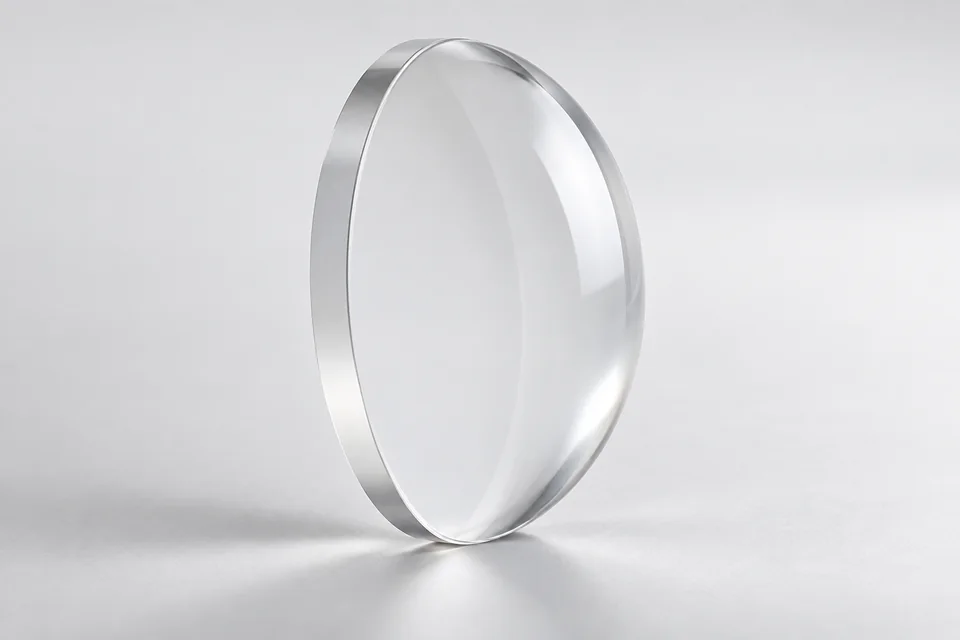
Plano Convex Lenses
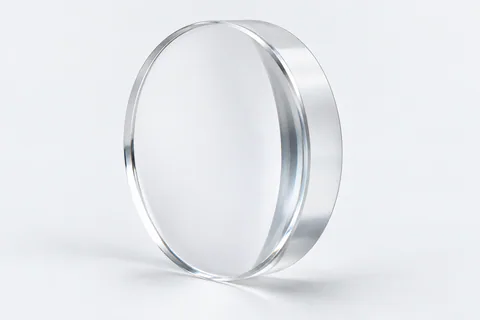
A lens with one flat and one convex surface, the most common single-element shape used to focus or collect light in general-purpose optical systems.
Share requirements, quantities and a drawing if available. Specifications and supply terms require confirmation.
Overview
A plano-convex (PCX) lens has one flat surface and one convex surface, making it the simplest and most widely used single-element focusing lens in general optical instrumentation, machine vision and beam-conditioning applications. Its flat side simplifies mounting and cleaning compared to a double-convex shape, which is part of why it is a standard catalog item across the optics industry. Procurement review should center on placing the curved face correctly to focus a collimated beam with limited spherical aberration.
Key Selection Points
- Simplest single-element shape for general focusing and light-collection tasks
- Flat mounting side simplifies housing and alignment
Applications
Plano-convex lenses are used across machine vision, general instrument optics, laser beam collimation/focusing and light-collection systems wherever a simple, low-cost, single-element focusing lens is sufficient.
Lens Geometry & Selection Guide
This module explains how lens geometry changes the selection path and the information required from the optical design. For Plano Convex Lenses, the module focuses on placing the curved face correctly to focus a collimated beam with limited spherical aberration.
- Show surface orientation, optical axis and conjugate or beam condition in the drawing.
- Include focal length, prescription and aberration targets with the enquiry for feasibility review.
- State tolerance and manufacturable-range requirements on the drawing for review.
- Product-specific review: connect focal length with plano-convex orientation and document the trade-off against a double-convex lens.
Prepare a product-specific enquiry
Include the requirements you know and identify any points that need confirmation.
| RFQ input | What to provide |
|---|---|
| Input 1 | Use case for Plano Convex Lenses: document placing the curved face correctly to focus a collimated beam with limited spherical aberration. |
| Input 2 | First decision pair: focal length versus clear aperture. |
| Input 3 | Integration pair: plano-convex orientation together with material and coating. |
| Input 4 | RFQ-specific instruction: state beam direction and whether the curved face points toward the collimated side. |
| Input 5 | Add the requested quantity and prototype or production stage. |
| Input 6 | Attach controlled drawings and identify the inspection or spectral evidence the buyer expects. |
Frequently Asked Questions
What is a plano-convex lens used for?
It is a general-purpose focusing or light-collecting lens, used wherever a simple single-element lens is sufficient — machine vision, instrument optics and beam conditioning are common uses.
What is the difference between plano-convex and double-convex lenses?
A plano-convex lens has one flat and one convex surface; a double-convex (biconvex) lens has two convex surfaces, which can reduce spherical aberration at certain conjugate ratios but is harder to mount flush.
Can you supply a custom diameter or coating?
Plano Convex Lenses requires this decision to be tied to focal length and clear aperture. Share your drawing or exact specification through the RFQ form and we will confirm feasibility.
Which specification should be fixed first for Plano Convex Lenses?
Begin with focal length. It determines how clear aperture and plano-convex orientation should be evaluated before the mechanical details are finalized.
When is Plano Convex Lenses a better fit than a double-convex lens?
Choose between them by testing the requirement for placing the curved face correctly to focus a collimated beam with limited spherical aberration. If that requirement is absent, the comparison product may provide a simpler procurement path.
Tell us what you are sourcing.
A product name, a specification or an application is a starting point.