
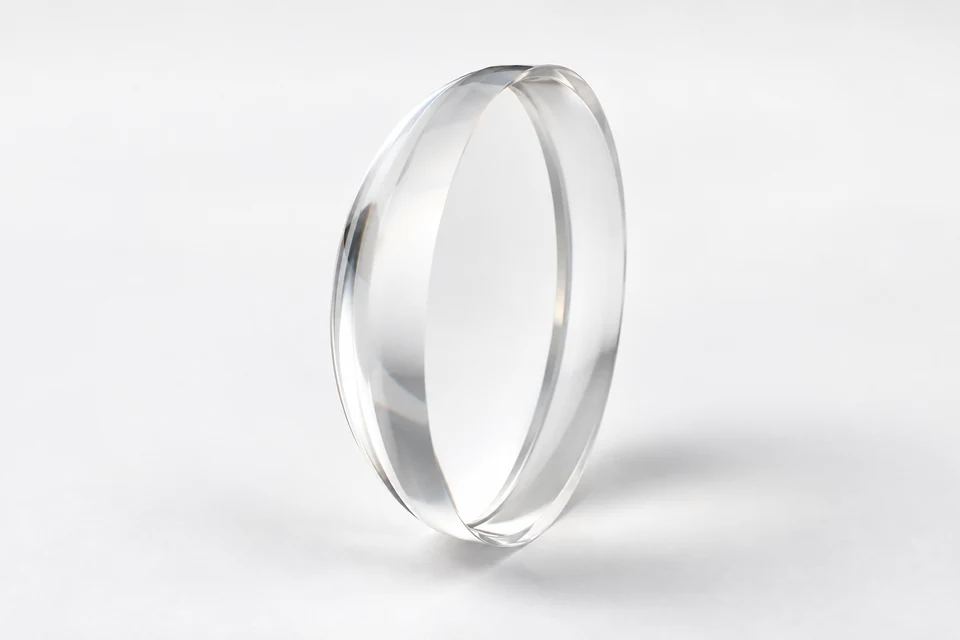
Meniscus Lenses
A lens with one convex and one concave surface, used to shorten focal length or raise numerical aperture in a paired optical system without adding spherical aberration.
Share requirements, quantities and a drawing if available. Specifications and supply terms require confirmation.
Overview
A meniscus lens has one convex and one concave surface, unlike plano or double-convex/concave shapes. This asymmetric profile lets it correct or reduce spherical aberration when paired with another lens, which is why it is commonly used downstream of a primary lens in IR imaging and spectroscopy systems rather than as a standalone element. Both positive (net converging) and negative (net diverging) meniscus forms exist depending on which surface has the stronger curvature. Procurement review should center on correcting spherical aberration in a paired optical path through meniscus orientation and power.
Key Selection Points
- Reduces spherical aberration when paired with another lens in a compact optical path
- Available in positive (converging) and negative (diverging) forms
Applications
Meniscus lenses are used downstream of a primary imaging or focusing lens in thermal-imaging cameras, IR spectroscopy instruments and general beam-conditioning paths, where their asymmetric curvature corrects aberration a single simple lens would introduce. They are also used in visible-spectrum instrument design wherever a compact, low-aberration secondary element is needed.
Lens Geometry & Selection Guide
This module explains how lens geometry changes the selection path and the information required from the optical design. For Meniscus Lenses, the module focuses on correcting spherical aberration in a paired optical path through meniscus orientation and power.
- Show surface orientation, optical axis and conjugate or beam condition in the drawing.
- Include focal length, prescription and aberration targets with the enquiry for feasibility review.
- State tolerance and manufacturable-range requirements on the drawing for review.
- Product-specific review: connect positive or negative form with focal requirement and document the trade-off against a plano-convex lens.
Prepare a product-specific enquiry
Include the requirements you know and identify any points that need confirmation.
| RFQ input | What to provide |
|---|---|
| Input 1 | Procurement objective for Meniscus Lenses: correcting spherical aberration in a paired optical path through meniscus orientation and power. |
| Input 2 | Lock positive or negative form before requesting a decision on surface orientation. |
| Input 3 | Describe focal requirement and the mating or operating condition for material, coating and mount. |
| Input 4 | Do not omit this product-specific point: state whether the element is positive or negative and how its concave face is oriented in the assembly. |
| Input 5 | Include quantity and project phase; MOQ, stock and lead time are confirmed during quotation. |
| Input 6 | Identify drawing revision, critical notes and evidence needed at acceptance. |
Frequently Asked Questions
What is the difference between a meniscus lens and a plano-convex lens?
A meniscus lens has one convex and one concave surface, while a plano-convex lens has one flat and one convex surface. The meniscus shape is chosen specifically to correct aberration when paired with another lens, not as a standalone focusing element.
Can I get a custom focal length or diameter?
Share your drawing or exact specification through the RFQ form and we will confirm feasibility.
Is a meniscus lens the same as an achromatic doublet?
No — a meniscus lens is a single element with two different curvatures; an achromatic doublet is two cemented elements of different materials chosen to correct chromatic aberration. They solve different problems.
Which specification should be fixed first for Meniscus Lenses?
Begin with positive or negative form. It determines how surface orientation and focal requirement should be evaluated before the mechanical details are finalized.
When is Meniscus Lenses a better fit than a plano-convex lens?
Choose between them by testing the requirement for correcting spherical aberration in a paired optical path through meniscus orientation and power. If that requirement is absent, the comparison product may provide a simpler procurement path.
Related Products & Resources
Explore Related Resources
Tell us what you are sourcing.
A product name, a specification or an application is a starting point.