
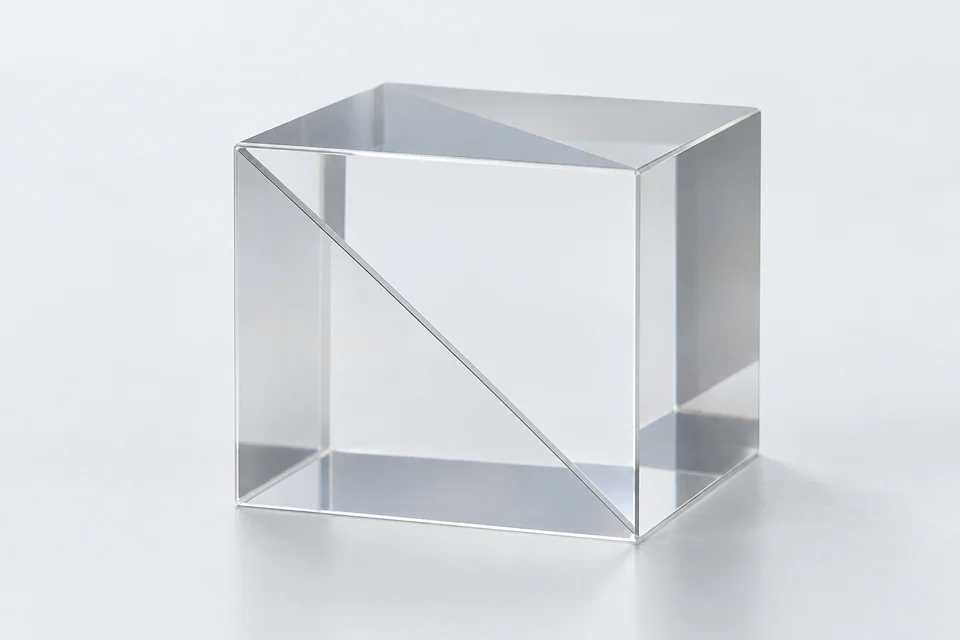
Non-Polarizing Beam Splitter Cubes (NPBS)
A cemented cube that splits an incoming beam by a fixed intensity ratio (such as 50/50), largely independent of polarization.
Share requirements, quantities and a drawing if available. Specifications and supply terms require confirmation.
Overview
A non-polarizing beam splitter cube is built the same way as a polarizing one — two cemented right-angle prisms with a thin-film coating on the hypotenuse — but the coating is designed to split light by a fixed reflect/transmit intensity ratio (commonly 50/50, though other ratios exist) with minimal dependence on the incoming light's polarization state. This is the more general-purpose beam splitter used where a buyer needs a predictable split ratio rather than a polarization-sorting function. Procurement review should center on dividing optical power with limited dependence on input polarization for a defined band.
Key Selection Points
- Splits light by a fixed intensity ratio (e.g. 50/50) largely independent of polarization, distinct from a polarizing beam splitter cube which sorts by polarization state
- General-purpose beam-sampling and beam-combining tool for laser and instrumentation setups
Applications
Non-polarizing beam splitter cubes are used to sample a fixed fraction of a laser or light beam for monitoring, or to combine two beams onto one path, in laser systems and general optical instrumentation.
Optical Principle & Light Path
This module makes the intended light path and component orientation explicit for review. For Non-Polarizing Beam Splitter Cubes (NPBS), the module focuses on dividing optical power with limited dependence on input polarization for a defined band.
- Diagram entrance and exit beams, optical axis and relevant face orientation.
- Identify wavelength, angle of incidence and polarization where they affect the principle.
- Use the light-path diagram to clarify component orientation; measured performance remains configuration-specific.
- Product-specific review: connect wavelength band with AOI and polarization range and document the trade-off against a polarizing beam splitter.
Prepare a product-specific enquiry
Include the requirements you know and identify any points that need confirmation.
| RFQ input | What to provide |
|---|---|
| Input 1 | Procurement objective for Non-Polarizing Beam Splitter Cubes (NPBS): dividing optical power with limited dependence on input polarization for a defined band. |
| Input 2 | Lock wavelength band before requesting a decision on target split ratio. |
| Input 3 | Describe AOI and polarization range and the mating or operating condition for cube orientation and cementing constraints. |
| Input 4 | Do not omit this product-specific point: state split-ratio basis, accepted polarization variation, wavelength band and port geometry. |
| Input 5 | Include quantity and project phase; MOQ, stock and lead time are confirmed during quotation. |
| Input 6 | Identify drawing revision, critical notes and evidence needed at acceptance. |
Frequently Asked Questions
Is this the same as a polarizing beam splitter cube?
No — see our Polarizing Beam Splitter Cubes page. A non-polarizing cube splits by a fixed intensity ratio regardless of polarization; a polarizing cube sorts light into two polarization states.
Can you supply a custom split ratio?
Share your target split ratio and wavelength through the RFQ form and we will confirm feasibility once a coating source is confirmed.
Which specification should be fixed first for Non-Polarizing Beam Splitter Cubes (NPBS)?
Begin with wavelength band. It determines how target split ratio and AOI and polarization range should be evaluated before the mechanical details are finalized.
When is Non-Polarizing Beam Splitter Cubes (NPBS) a better fit than a polarizing beam splitter?
Choose between them by testing the requirement for dividing optical power with limited dependence on input polarization for a defined band. If that requirement is absent, the comparison product may provide a simpler procurement path.
What should an RFQ for Non-Polarizing Beam Splitter Cubes (NPBS) include?
State split-ratio basis, accepted polarization variation, wavelength band and port geometry. Also include quantity, drawing revision and the required acceptance evidence. Final availability is confirmed during quotation.
Related Products & Resources


Explore Related Resources
Tell us what you are sourcing.
A product name, a specification or an application is a starting point.