
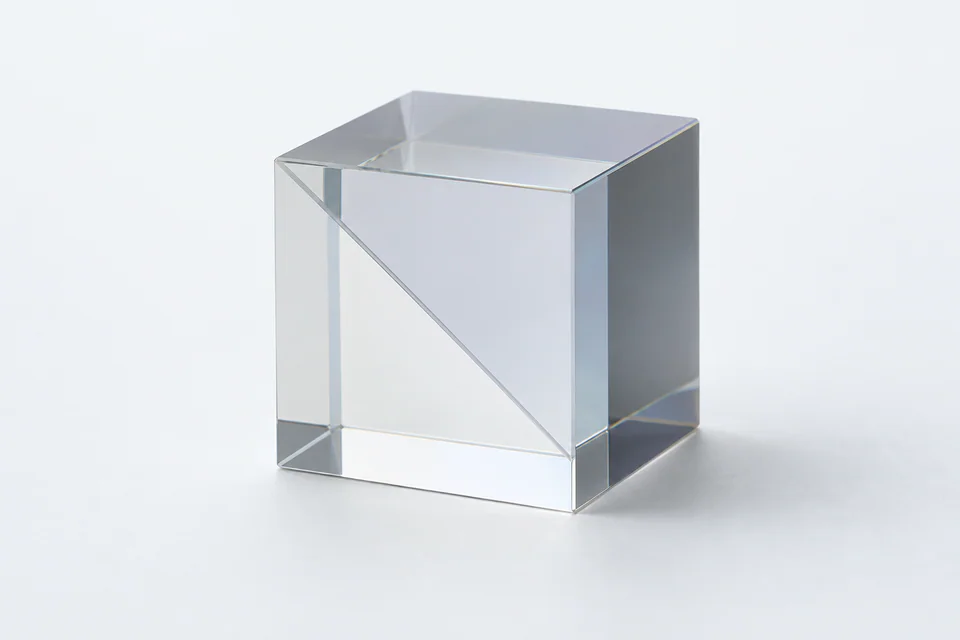
Polarizing Beam Splitter Cubes (PBS)
A cemented cube that splits an incoming beam into two orthogonally polarized outputs — reflected and transmitted.
Share requirements, quantities and a drawing if available. Specifications and supply terms require confirmation.
Overview
A polarizing beam splitter cube is built from two right-angle prisms cemented together along a polarizing thin-film coating on the hypotenuse, so that it reflects one polarization state (typically S) and transmits the other (P) as separate output beams. This is a real, spec-driven photonics component — its usefulness is defined by extinction ratio and wavelength range, which is why it is a standard building block in laser systems and photonics instrumentation rather than a general beam-splitting accessory. Procurement review should center on splitting orthogonal polarization states into separate paths with a defined cube orientation.
Key Selection Points
- Splits incoming light into two orthogonally polarized output beams by reflection and transmission, distinct from a non-polarizing beam splitter which splits by intensity ratio regardless of polarization
- Performance is defined by extinction ratio and design wavelength range — a real spec-driven photonics component
Applications
Polarizing beam splitter cubes are used in laser systems and photonics instrumentation to separate a beam into two polarization-defined paths — for example, directing one polarization to a detector while the other continues through an optical path.
Optical Principle & Light Path
This module makes the intended light path and component orientation explicit for review. For Polarizing Beam Splitter Cubes (PBS), the module focuses on splitting orthogonal polarization states into separate paths with a defined cube orientation.
- Diagram entrance and exit beams, optical axis and relevant face orientation.
- Identify wavelength, angle of incidence and polarization where they affect the principle.
- Use the light-path diagram to clarify component orientation; measured performance remains configuration-specific.
- Product-specific review: connect wavelength with split-path geometry and document the trade-off against a non-polarizing beam splitter.
Prepare a product-specific enquiry
Include the requirements you know and identify any points that need confirmation.
| RFQ input | What to provide |
|---|---|
| Input 1 | System context: explain why Polarizing Beam Splitter Cubes (PBS) is being considered for splitting orthogonal polarization states into separate paths with a defined cube orientation. |
| Input 2 | Required optical definition: wavelength, then input polarization. |
| Input 3 | Required physical definition: split-path geometry, then coating face and cube orientation. |
| Input 4 | Product distinction to record: state which polarization exits each port, wavelength, AOI and required port orientation. |
| Input 5 | Provide the required quantity and program phase. |
| Input 6 | List the applicable drawing, test reference and acceptance basis. |
Frequently Asked Questions
What is the difference between a polarizing and a non-polarizing beam splitter cube?
A polarizing beam splitter cube separates light into two orthogonal polarization states (reflecting one, transmitting the other); a non-polarizing beam splitter cube splits the beam by an intensity ratio (e. g. 50/50) regardless of polarization. See our Non-Polarizing Beam Splitter Cubes page for that alternative.
Which specification should be fixed first for Polarizing Beam Splitter Cubes (PBS)?
Begin with wavelength. It determines how input polarization and split-path geometry should be evaluated before the mechanical details are finalized.
When is Polarizing Beam Splitter Cubes (PBS) a better fit than a non-polarizing beam splitter?
Choose between them by testing the requirement for splitting orthogonal polarization states into separate paths with a defined cube orientation. If that requirement is absent, the comparison product may provide a simpler procurement path.
What should an RFQ for Polarizing Beam Splitter Cubes (PBS) include?
State which polarization exits each port, wavelength, AOI and required port orientation. Also include quantity, drawing revision and the required acceptance evidence. Final availability is confirmed during quotation.
Which details for Polarizing Beam Splitter Cubes (PBS) still require supplier verification?
Actual material and coating availability, dimensional limits, tolerances, inspection reports, MOQ and lead time cannot be inferred from this page and must be confirmed against the RFQ.

Tell us what you are sourcing.
A product name, a specification or an application is a starting point.