
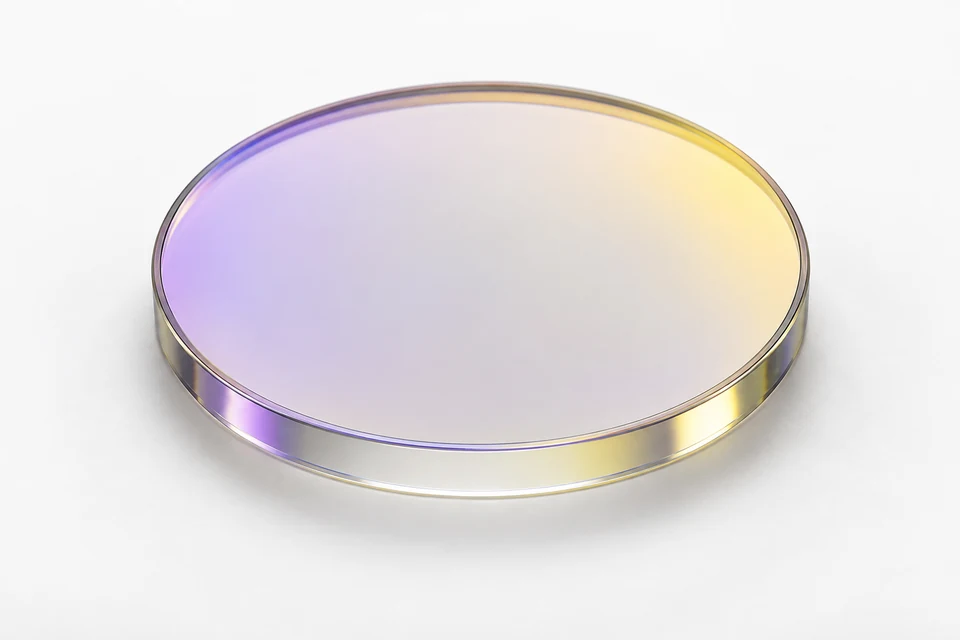
Notch Filters
A filter that blocks a narrow band at a specific wavelength while transmitting everything else, most often used to reject laser light.
Share requirements, quantities and a drawing if available. Specifications and supply terms require confirmation.
Overview
A notch filter blocks a narrow band centered on a specific wavelength while transmitting everything else — the inverse of a laser line filter, which transmits the narrow band and blocks everything else. Notch filters typically use rugate or holographic gradient-index coating technology rather than the standard multilayer stacks used in Bandpass/Dichroic filters, which is a more specialized coating process and carries the highest coating-capability verification requirement of any filter type in this catalog. Procurement review should center on rejecting a narrow unwanted line while preserving wavelengths on both sides.
Key Selection Points
- Blocks a narrow band at one wavelength while transmitting the rest of the spectrum, the inverse function of a laser line filter
- Standard tool for rejecting laser excitation light in Raman spectroscopy and for laser-safety eyewear/viewing windows
- Rugate/holographic coating technology is more specialized than standard multilayer filter coatings
Applications
Notch filters are used in Raman spectroscopy to reject the laser excitation line while passing the much weaker Raman-scattered signal, and in laser-safety viewing windows to block a specific hazardous laser wavelength.
Spectral Performance
This module explains which spectral variables must be defined before measured performance can be reviewed. For Notch Filters, the module focuses on rejecting a narrow unwanted line while preserving wavelengths on both sides.
- Review measured performance against supplier or test-lab data tied to the exact configuration.
- Record wavelength region, angle of incidence and polarization with the measurement context.
- Confirm transmission, reflectance and blocking requirements against approved evidence for the selected configuration.
- Product-specific review: connect notch center with pass regions on both sides and document the trade-off against a bandpass filter.
Prepare a product-specific enquiry
Include the requirements you know and identify any points that need confirmation.
| RFQ input | What to provide |
|---|---|
| Input 1 | System context: explain why Notch Filters is being considered for rejecting a narrow unwanted line while preserving wavelengths on both sides. |
| Input 2 | Required optical definition: notch center, then rejection width. |
| Input 3 | Required physical definition: pass regions on both sides, then AOI, polarization and blocking depth method. |
| Input 4 | Product distinction to record: state unwanted line, protected pass regions, AOI and detector sensitivity. |
| Input 5 | Provide the required quantity and program phase. |
| Input 6 | List the applicable drawing, test reference and acceptance basis. |
Frequently Asked Questions
What is the difference between a notch filter and a laser line filter?
A notch filter blocks a narrow band at one wavelength and transmits everything else; a laser line filter does the opposite, transmitting the narrow band and blocking everything else. See our Laser Line Filters page for that alternative.
Which specification should be fixed first for Notch Filters?
Begin with notch center. It determines how rejection width and pass regions on both sides should be evaluated before the mechanical details are finalized.
When is Notch Filters a better fit than a bandpass filter?
Choose between them by testing the requirement for rejecting a narrow unwanted line while preserving wavelengths on both sides. If that requirement is absent, the comparison product may provide a simpler procurement path.
What should an RFQ for Notch Filters include?
State unwanted line, protected pass regions, AOI and detector sensitivity. Also include quantity, drawing revision and the required acceptance evidence. Final availability is confirmed during quotation.
Which details for Notch Filters still require supplier verification?
Actual material and coating availability, dimensional limits, tolerances, inspection reports, MOQ and lead time cannot be inferred from this page and must be confirmed against the RFQ.
Related Products & Resources
Explore Related Resources
Tell us what you are sourcing.
A product name, a specification or an application is a starting point.