
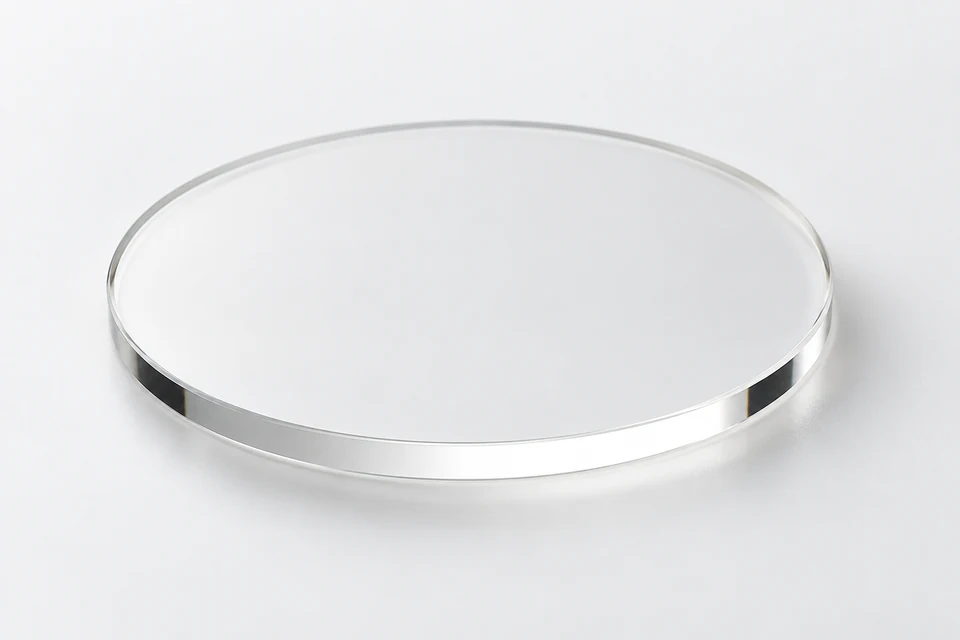
Optical Flat Windows
An ultra-high-flatness reference window used in interferometry and metrology to test or calibrate other optical surfaces, not a general-purpose viewing or protective window.
Share requirements, quantities and a drawing if available. Specifications and supply terms require confirmation.
Overview
An optical flat is a window ground and polished to an extremely high surface flatness — commonly specified as a fraction of a wavelength (for example lambda/4, lambda/10 or lambda/20 peak-to-valley) — so that it can itself serve as a reference standard in interferometric testing, calibration and metrology work. This is a fundamentally different buyer need from a general protective or transmission window: the flat's own surface accuracy is the product, not just its material transmission. Procurement review should center on using surface flatness as a reference or test function rather than merely covering an aperture.
Key Selection Points
- Surface flatness specified as a fraction of a wavelength, suitable for use as an interferometric reference
- Common substrates include fused silica and BK7 for their low thermal expansion and polishability
- Used to test or calibrate other optical surfaces, not primarily for viewing or protection
Applications
Optical flats are used in interferometry to test the flatness of other optical surfaces, in metrology labs for calibration reference standards, and in some precision instrument assemblies where a known, verified flat reference surface is required rather than a simple transmissive window.
Structure & Configuration
This module describes the physical configuration and interfaces that distinguish the product from a generic optic. For Optical Flat Windows, the module focuses on using surface flatness as a reference or test function rather than merely covering an aperture.
- Use a labeled cross-section or configuration drawing with clear datums.
- Separate optical clear zones from mounting, sealing and handling surfaces.
- Include dimensional and inspection requirements with the enquiry for feasibility review.
- Product-specific review: connect working aperture with reference-face use and document the trade-off against a normal protective window.
Prepare a product-specific enquiry
Include the requirements you know and identify any points that need confirmation.
| RFQ input | What to provide |
|---|---|
| Input 1 | System context: explain why Optical Flat Windows is being considered for using surface flatness as a reference or test function rather than merely covering an aperture. |
| Input 2 | Required optical definition: working aperture, then flatness or wavefront requirement. |
| Input 3 | Required physical definition: reference-face use, then inspection wavelength and report need. |
| Input 4 | Product distinction to record: state whether the flat is a reference, interferometer component or transmission window and name the acceptance method. |
| Input 5 | Provide the required quantity and program phase. |
| Input 6 | List the applicable drawing, test reference and acceptance basis. |
Frequently Asked Questions
What does 'lambda/10' flatness mean?
It means the surface deviates from a perfect plane by no more than one-tenth of the test wavelength (commonly 632. 8nm) across the surface — a standard way optical flats are specified in this market.
How is an optical flat different from a regular optical window?
A regular window is specified mainly by transmission and general flatness for imaging use; an optical flat's own surface accuracy is the product, used as a reference standard in testing other optics.
Can you supply a custom diameter?
Optical Flat Windows requires this decision to be tied to working aperture and flatness or wavefront requirement. Share your drawing or exact specification through the RFQ form and we will confirm feasibility.
Which specification should be fixed first for Optical Flat Windows?
Begin with working aperture. It determines how flatness or wavefront requirement and reference-face use should be evaluated before the mechanical details are finalized.
When is Optical Flat Windows a better fit than a normal protective window?
Choose between them by testing the requirement for using surface flatness as a reference or test function rather than merely covering an aperture. If that requirement is absent, the comparison product may provide a simpler procurement path.
Related Products & Resources
Explore Related Resources
Tell us what you are sourcing.
A product name, a specification or an application is a starting point.