
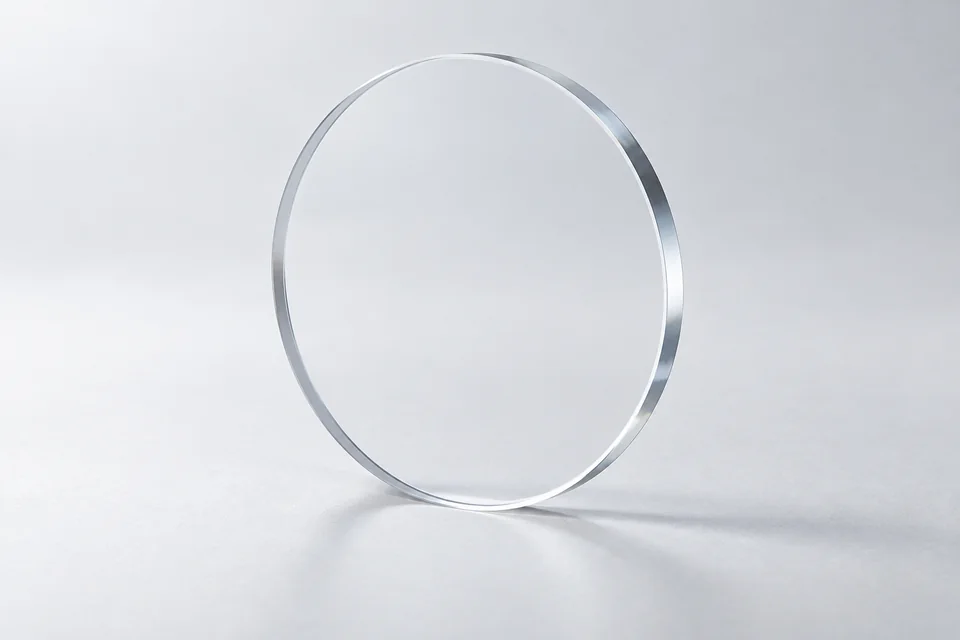
BK7 / K9 Optical Windows
A general-purpose visible-spectrum optical window made from BK7 or the equivalent K9 borosilicate crown glass grade.
Share requirements, quantities and a drawing if available. Specifications and supply terms require confirmation.
Overview
BK7 (the Schott designation) and K9 (the equivalent Chinese/Russian designation) are the same borosilicate crown-glass grade, marketed interchangeably across this market and used as the standard, most widely available window material for general visible-spectrum instrument, machine-vision and optical-assembly use. This page covers both naming conventions as one product, since they describe the same underlying material rather than two different products. Procurement review should center on using an economical visible or near-infrared window where transmitted wavefront and coating needs are application-specific.
Key Selection Points
- The most widely available, standardized visible-spectrum optical glass in the industry
- BK7 and K9 are the same material under different regional naming conventions
- Suits general-purpose visible-light instrument and machine-vision windows
Applications
BK7/K9 windows are used as general protective or transmissive windows in visible-spectrum instruments, machine-vision camera housings, and optical assemblies where cost-effective, well-characterized glass is preferred over a specialty IR or UV material.
Wavelength Range & Material Guide
This module connects wavelength needs with material choice while keeping reference properties separate from configuration-specific performance. For BK7 / K9 Optical Windows, the module focuses on using an economical visible or near-infrared window where transmitted wavefront and coating needs are application-specific.
- Separate general material behavior from the exact grade and coating offered for the RFQ.
- Review environmental, thermal and handling constraints alongside the wavelength band.
- Confirm any numerical transmission range for the selected material, coating and configuration.
- Product-specific review: connect spectral band with flatness or wavefront need and document the trade-off against fused-silica windows.
Prepare a product-specific enquiry
Include the requirements you know and identify any points that need confirmation.
| RFQ input | What to provide |
|---|---|
| Input 1 | Define the buyer objective for BK7 / K9 Optical Windows: using an economical visible or near-infrared window where transmitted wavefront and coating needs are application-specific. |
| Input 2 | Optical inputs: spectral band; BK7 or K9 material designation. |
| Input 3 | Geometry and interface: flatness or wavefront need; coating, thickness and mount. |
| Input 4 | Special review note: state imaging or protection use, wavelength band and whether the window is tilted. |
| Input 5 | State quantity and project stage without assuming MOQ, inventory or delivery timing. |
| Input 6 | Name the drawing revision and acceptance evidence required for review. |
Frequently Asked Questions
Is BK7 the same as K9?
Yes — BK7 is the Schott (German) designation and K9 is the equivalent Chinese/Russian designation for the same borosilicate crown glass grade. Suppliers in this market use the terms interchangeably.
Do I need a coated or uncoated window for BK7 / K9 Optical Windows?
Depends on your application's reflection-loss tolerance — tell us your use case through the RFQ form and we will confirm coating options.
Can you supply a custom size?
BK7 / K9 Optical Windows requires this decision to be tied to spectral band and BK7 or K9 material designation. Share your drawing or exact dimensions through the RFQ form and we will confirm feasibility.
Which specification should be fixed first for BK7 / K9 Optical Windows?
Begin with spectral band. It determines how BK7 or K9 material designation and flatness or wavefront need should be evaluated before the mechanical details are finalized.
When is BK7 / K9 Optical Windows a better fit than fused-silica windows?
Choose between them by testing the requirement for using an economical visible or near-infrared window where transmitted wavefront and coating needs are application-specific. If that requirement is absent, the comparison product may provide a simpler procurement path.
Related Products & Resources
Fused Silica Optical Windows
View product →
Plano Convex Lenses
View product →
Optical Flat Windows
View product →Explore Related Resources
Tell us what you are sourcing.
A product name, a specification or an application is a starting point.