
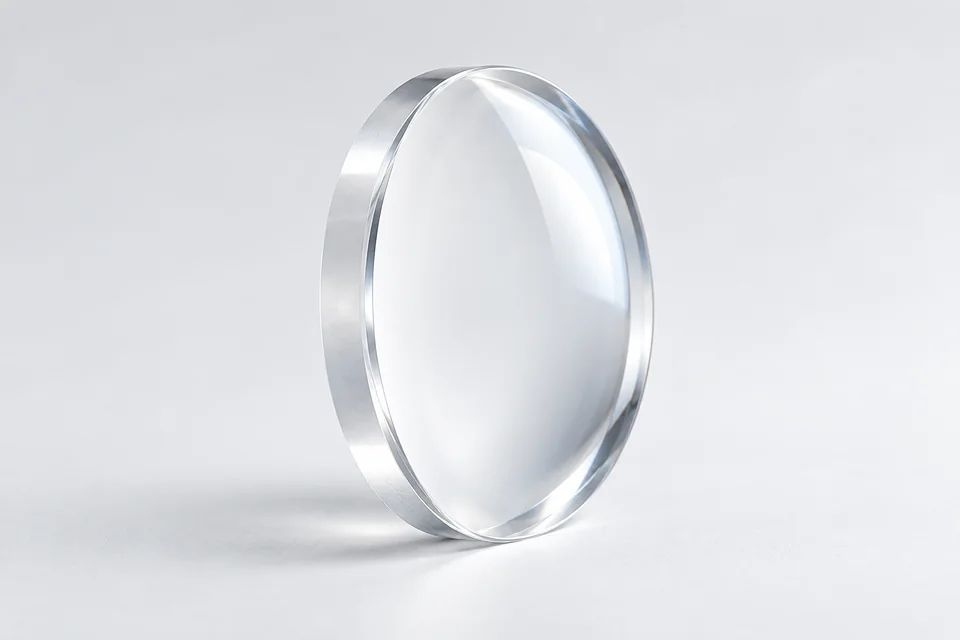
Fused Silica Lenses
A lens ground from fused silica (quartz), chosen specifically for its transmission into the deep UV where standard BK7-based lenses absorb strongly.
Share requirements, quantities and a drawing if available. Specifications and supply terms require confirmation.
Overview
Fused silica lenses use the same material as Dongqiao's existing Fused Silica Optical Windows page but in lens form — ground into plano-convex, plano-concave or cylindrical shapes. The reason to specify fused silica over a standard glass lens is its transmission down into the deep UV and its low thermal expansion, both relevant to UV instrumentation, laser and spectroscopy applications where a standard BK7 lens would absorb too much or drift with temperature. Procurement review should center on combining fused-silica material behavior with a lens geometry selected for UV, visible or near-infrared use.
Key Selection Points
- Transmits into the deep UV where standard optical glass absorbs strongly
- Low thermal expansion supports stability in temperature-sensitive optical paths
- Available in the same standard shapes as glass lenses (plano-convex, plano-concave, cylindrical)
Applications
Fused silica lenses are used in UV spectroscopy, excimer and other UV laser systems, and general scientific instrumentation where transmission below roughly 300nm or thermal stability matters more than the lower cost of a standard glass lens.
Lens Geometry & Selection Guide
This module explains how lens geometry changes the selection path and the information required from the optical design. For Fused Silica Lenses, the module focuses on combining fused-silica material behavior with a lens geometry selected for UV, visible or near-infrared use.
- Show surface orientation, optical axis and conjugate or beam condition in the drawing.
- Include focal length, prescription and aberration targets with the enquiry for feasibility review.
- State tolerance and manufacturable-range requirements on the drawing for review.
- Product-specific review: connect wavelength band with fused-silica grade and document the trade-off against BK7/K9 lenses.
Prepare a product-specific enquiry
Include the requirements you know and identify any points that need confirmation.
| RFQ input | What to provide |
|---|---|
| Input 1 | Procurement objective for Fused Silica Lenses: combining fused-silica material behavior with a lens geometry selected for UV, visible or near-infrared use. |
| Input 2 | Lock wavelength band before requesting a decision on lens form and focal requirement. |
| Input 3 | Describe fused-silica grade and the mating or operating condition for coating and thermal environment. |
| Input 4 | Do not omit this product-specific point: provide band, focal objective, element orientation and any thermal cycling context. |
| Input 5 | Include quantity and project phase; MOQ, stock and lead time are confirmed during quotation. |
| Input 6 | Identify drawing revision, critical notes and evidence needed at acceptance. |
Frequently Asked Questions
Why use a fused silica lens instead of a standard BK7 lens?
Fused silica transmits much further into the UV than BK7 and has lower thermal expansion, which matters for UV instrumentation and temperature-sensitive optical paths.
Which specification should be fixed first for Fused Silica Lenses?
Begin with wavelength band. It determines how lens form and focal requirement and fused-silica grade should be evaluated before the mechanical details are finalized.
When is Fused Silica Lenses a better fit than BK7/K9 lenses?
Choose between them by testing the requirement for combining fused-silica material behavior with a lens geometry selected for UV, visible or near-infrared use. If that requirement is absent, the comparison product may provide a simpler procurement path.
What should an RFQ for Fused Silica Lenses include?
Provide band, focal objective, element orientation and any thermal cycling context. Also include quantity, drawing revision and the required acceptance evidence. Final availability is confirmed during quotation.
Which details for Fused Silica Lenses still require supplier verification?
Actual material and coating availability, dimensional limits, tolerances, inspection reports, MOQ and lead time cannot be inferred from this page and must be confirmed against the RFQ.
Related Products & Resources
Fused Silica Optical Windows
View product →
Cylindrical Lenses
View product →
Plano Convex Lenses
View product →Explore Related Resources
Tell us what you are sourcing.
A product name, a specification or an application is a starting point.